
Will the stock market crash? It is the question that keeps investors awake at night, dominates Wall Street conversations, and floods financial search engines every time the market gets turbulent. And in 2026, the question has never felt more urgent.
After three consecutive years of double-digit gains, the S&P 500 entered 2026 at record highs then promptly stumbled. Tariff wars, geopolitical shocks, soaring oil prices, record-high valuations, and a deeply divided Federal Reserve have combined into a perfect storm of uncertainty. Millions of everyday investors, retirement savers, and institutional portfolio managers are all asking the same critical question: will the stock market crash?
In this comprehensive, fully researched guide, we examine every major risk factor that could cause a stock market crash, what the world’s most respected financial institutions and investors are saying, the key warning signals flashing right now, and exactly how to protect your wealth regardless of what happens next.
Let’s get into it.
Table of Contents
Where Does the Stock Market Stand Right Now? (April 2026)
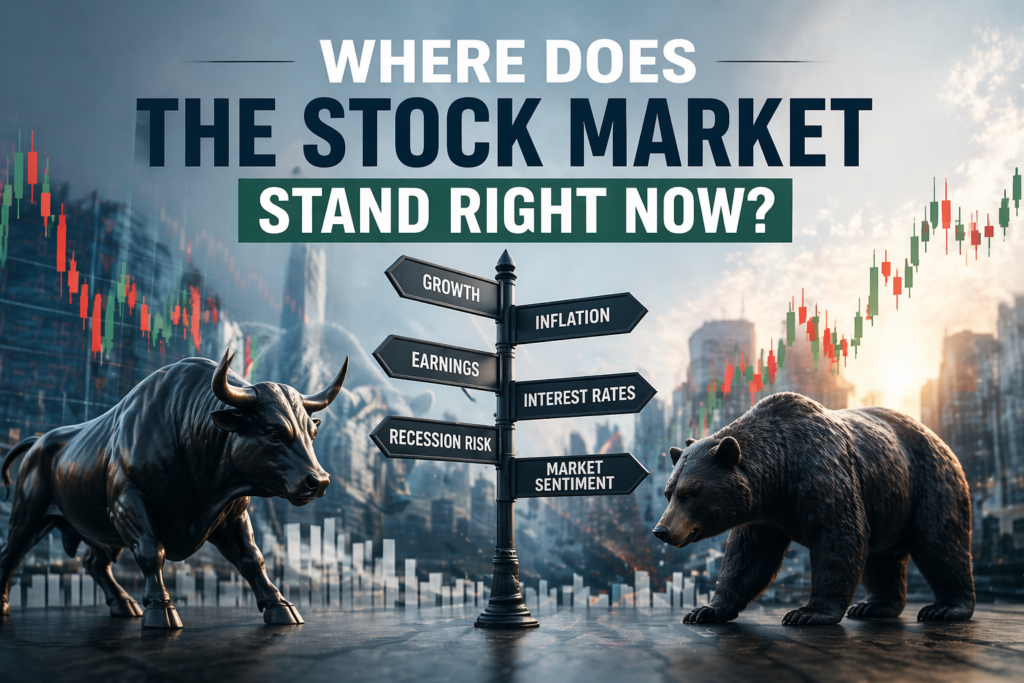
Before answering will the stock market crash, we need to understand what the market has already done and where it currently sits.
The S&P 500 added 16% in 2025, marking the third consecutive year in which the benchmark index recorded double-digit gains. Unfortunately, investors have reason to think 2026 will be more challenging. Evidence suggests President Trump’s tariffs are hurting the economy, and the stock market flashed a warning last seen during the dot-com crash in 2000. The Motley Fool
After the S&P 500 gained more than 16% in 2025, investors entered 2026 hoping for more of the same but that hasn’t happened. The large-cap stock index is down roughly 7% year to date, while the Dow Jones Industrial Average has slipped about 8%, and the tech-heavy Nasdaq Composite has fallen more than 10%. The Motley Fool
U.S. stock markets entered 2026 at record highs, but recent volatility has raised a common question: Is a market correction coming? The pullback reflects rising geopolitical risk tied to the Iran conflict, which has pushed energy prices higher and disrupted global trade routes. U.S. Bank
The backdrop is clear: the stock market is under pressure. But will a correction deepen into a full-blown crash? That’s what we need to examine carefully.
Will the Stock Market Crash? What the Experts Are Actually Saying
The most important thing to understand about whether the stock market will crash is that Wall Street’s biggest institutions are divided but most of them stop short of predicting a catastrophic collapse.
Goldman Sachs
Goldman Sachs’ strategy group puts US recession odds at 25% and calls for continued expansion, with a base-case 7% stock market return and 10% earnings growth in 2026. Bloomberg’s survey of Wall Street predictions has a base case of around 2.1% US real GDP growth and a supportive environment for risk assets. Yahoo!
Morgan Stanley, Fidelity, and Oppenheimer
While industry insiders are generally cautious, few expect a crash. Morgan Stanley notes “continued equity gains in 2026” with modest growth, as a lot of good news is already priced in. Fidelity’s 2026 outlook is that it “could be another positive year” for the market but investors shouldn’t ignore risks. Oppenheimer expects a bullish year with a “broadening of the powerful rally” that began after 2022, supported by resilient earnings and moderating inflation. Yahoo!
Wall Street Consensus
Among analysts at 21 investment banks and research institutions, the S&P 500 has an average year-end target price of 7,459. That implies 7% upside from its current level of 6,967. The Motley Fool
Michael Burry – The Contrarian Bear
Not everyone is optimistic. Among those voicing concerns about a potential stock market crash is Michael Burry, famously portrayed in ‘The Big Short’. He has made comments about overinflated AI valuations, accusing firms of “spending money on each other.” He has also pointed out the crossover of household equity wealth and real estate wealth a rare event that has only occurred twice before, in the late 1960s and late 1990s. Both previous instances were followed by multi-year bear markets. Burry has put in short positions on Nvidia and Palantir, two of the biggest tech giants driving the AI boom. Yahoo!
Moody’s AI Recession Model – The Most Alarming Signal
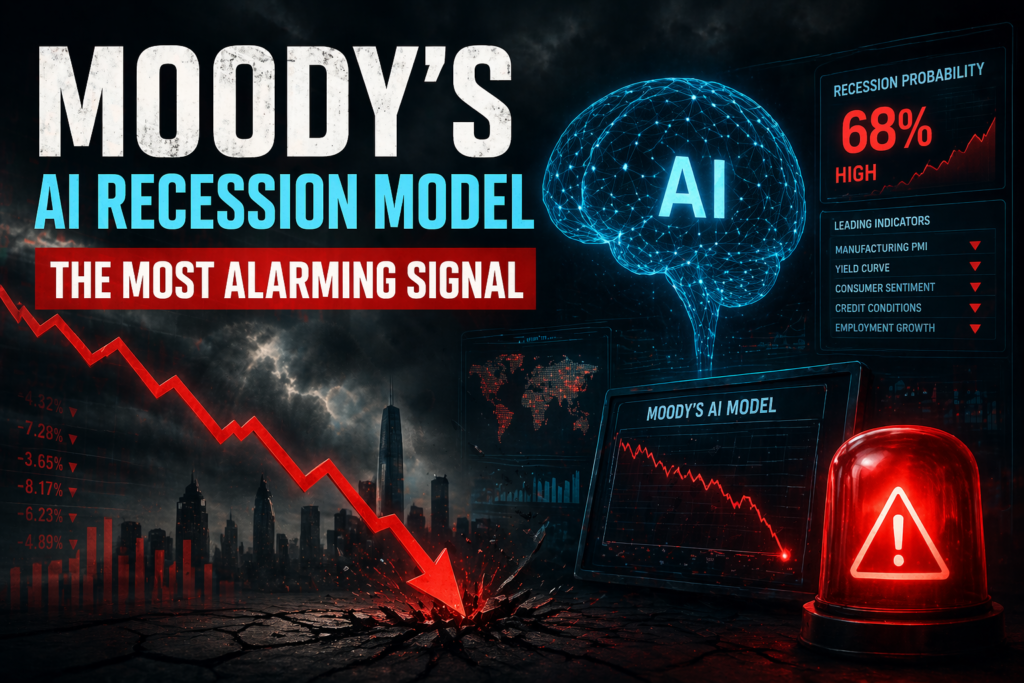
Moody’s AI-driven recession model has reached 49% probability and historically, once it crosses 50%, a recession has followed within a year. That 49% reading was for February before the U.S.-Iran war cut off 20% of the world’s crude oil supply and sent prices surging to nearly $120 a barrel. The Motley Fool
The bottom line from experts: will the stock market crash? A full, catastrophic crash is not the base case but a significant correction of 15–30% is very much on the table, and the risks are real and rising.
8 Major Risk Factors That Could Cause the Stock Market to Crash
1. Extreme Valuations – The CAPE Ratio Warning
This is perhaps the most consistently cited warning signal when analysts discuss whether the stock market will crash.
In December, the S&P 500 had an average CAPE ratio of 39.4, the most expensive multiple since the dot-com crash in October 2000. The Motley Fool
The Shiller P/E ratio stands above 40.5, marking the second-highest level in market history. Market experts calculate an 8% chance that stocks will plunge at least 30% from their current level in the next year. Intellectia.AI
The CAPE ratio measures earnings over a 10-year inflation-adjusted period, smoothing out short-term noise. When it reaches levels this extreme, it has historically been a reliable long-run warning. It doesn’t predict the timing of a crash but it does tell you that when the crash comes, it tends to be severe.
2. The Buffett Indicator Is Screaming Danger
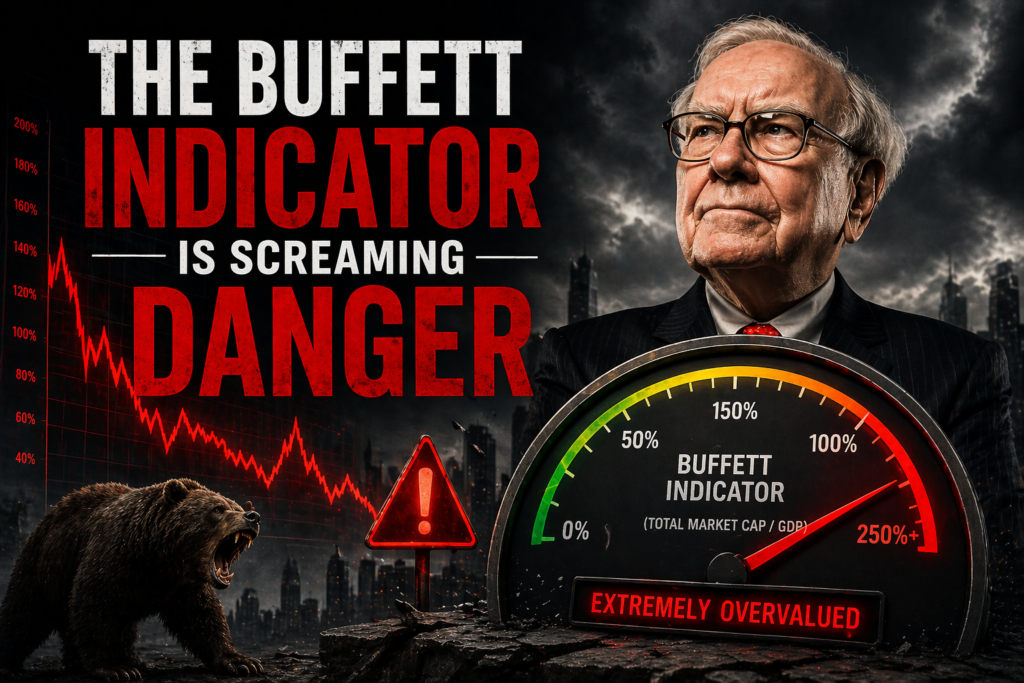
The Buffett Indicator now stands at 232%, a figure that’s around one-sixth higher than what Buffett himself identified as the “prepare-for-a-roasting zone.” The S&P 500 has rebounded over 13% from the Iran war decline to notch an all-time record of 7,140. A reading this elevated means corporate profits have been growing much faster than GDP. Fortune
The Buffett Indicator which compares total stock market value to GDP has historically been one of the most reliable long-term indicators of overvaluation. The Buffett Indicator sits at a worrying 221%, last reaching close to 200% right before the S&P 500 entered a bear market. Intellectia.AI
Warren Buffett himself has taken notice: Warren Buffett’s Berkshire Hathaway has been a net seller of stock for three consecutive years, suggesting that reasonably priced buying opportunities have been hard to find. Nasdaq
When the world’s greatest long-term investor is consistently selling and building cash, that is not a signal to ignore.
3. President Trump’s Tariffs – A Serious Economic Headwind
Will the stock market crash because of tariffs? The data is deeply concerning.
President Trump broke with decades of trade-policy precedent and imposed sweeping tariffs that raised the average tax on U.S. imports to 16.8%, the highest level since 1935. Researchers at the Federal Reserve Bank of San Francisco reviewed 150 years’ worth of data and arrived at this conclusion: Tariffs have historically led to higher unemployment and slower economic growth. And anything that bodes ill for the economy also bodes ill for the stock market. The Motley Fool
Trump’s trade policies have already coincided with a weakening jobs market, and recent Federal Reserve research indicates that tariffs have historically been a headwind to economic growth. The Motley Fool
Tariff policies have pushed average rates from 2% to 12%. Goldman Sachs estimates consumers will absorb a significant portion of these costs. You have tariffs squeezing consumers and threatening corporate margins. You have AI spending at potentially unsustainable levels. Any one of these could trigger a correction. All of them happening at once creates genuine systemic risk.Financer.
Read More : When Crypto Market Will Go Up : Expert Predictions & Recovery Timeline 2026
4. The Federal Reserve Is Deeply Divided
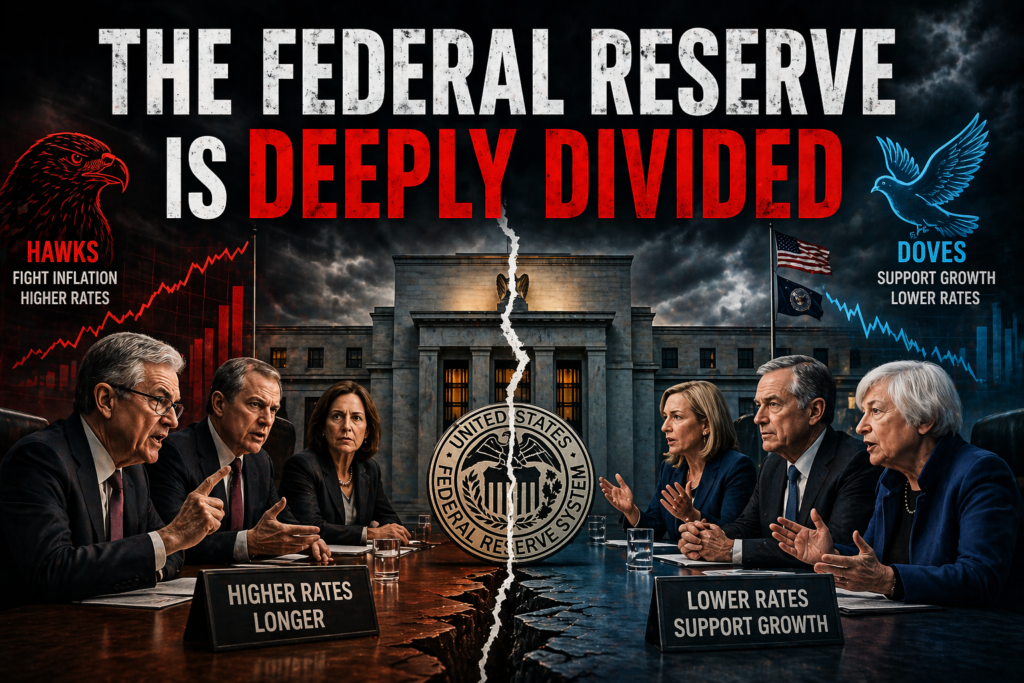
A split Fed is bad news for markets, because it signals that the economic picture is too unclear for even the smartest economists to read.
Something strange happened when the Federal Open Market Committee met in December. While policymakers cut interest rates by 25 basis points as expected, they were notably divided about the decision. Three FOMC members dissented, and they did so in opposite directions. Multiple dissents are theoretically bad news for the stock market. If experts are divided on the appropriate monetary policy, it suggests that economic conditions are difficult to interpret, and the stock market dislikes uncertainty. The Motley Fool
Goldman Sachs projects 2 rate cuts in 2026 while J.P. Morgan expects none. This confusion makes it nearly impossible for markets to price future conditions accurately. And the Fed now faces a nightmare scenario: rising prices from oil and tariffs (which normally call for higher rates) combined with slowing growth (which normally call for lower rates). The economic foundation hasn’t completely crumbled. GDP growth continues in the 2.2–2.8% range, supported by ongoing fiscal stimulus. Corporate earnings remain strong across most sectors. Financer
5. Geopolitical Risk – The Iran War Oil Shock
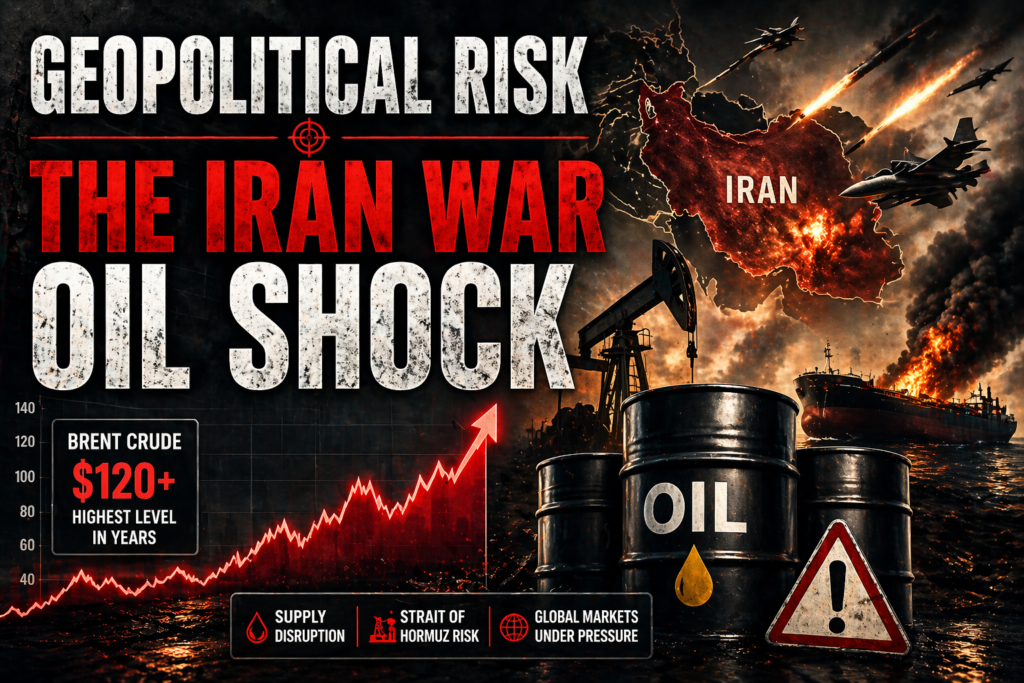
The U.S.-Iran war has driven Brent crude oil prices above $100 per barrel for the first time since 2022. Moody’s chief economist Mark Zandi says the situation could push the U.S. economy into a recession. The Motley Fool
JPMorgan Chase strategists warned that “a sustained oil price as high as $90 per barrel would likely catalyze a 10% to 15% decline in the S&P 500.” They also outlined a domino effect where every 10% drop in the U.S. stock market could reduce consumer spending by 1%, magnifying the oil shock’s impact on the economy. Goldman Sachs strategists recently warned that severe disruptions to global oil supplies could drag the S&P 500 down to 5,400 in 2026 a 22% decline from its January peak. The Motley Fool
Energy price shocks have historically been among the most reliable precursors of recessions. They hit consumers directly, compress corporate margins, and stoke inflationary pressure at the worst possible time.
6. Weakening Labor Market and Consumer Sentiment
The latest jobs report showed the U.S. lost 92,000 jobs, contrary to economists’ expectations of a gain of 59,000. Unemployment ticked up to 4.4% still relatively low, but headed in the wrong direction. The latest GDP numbers were revised down heavily from 1.4% to 0.7%. Meanwhile, inflation remains stubbornly above the Federal Reserve’s 2% target and shows signs of creeping higher. The Motley Fool
A whopping 72% of Americans have a negative view of the economy right now, according to a February 2026 survey from the Pew Research Center, with nearly 40% believing economic conditions will be worse a year from now. The Motley Fool
Consumer sentiment is one of the most powerful self-fulfilling indicators in economics. When people feel bad about the economy, they spend less. When they spend less, corporate earnings fall. When earnings fall, the stock market follows.
7. The AI Bubble Risk
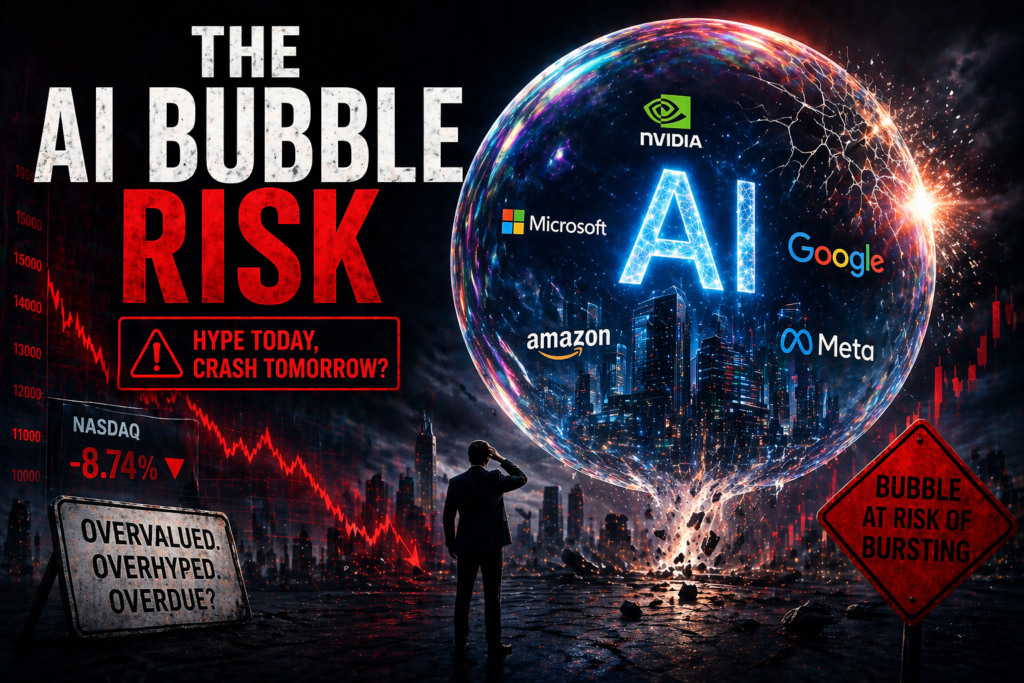
As of late December, a market rotation out of info tech brought the AI trade to a screeching halt. Whether that persists in 2026 will be a major area of focus, especially as analysts predict muted growth in technology earnings versus prior years. These sectors house five of the Magnificent Seven stocks and represent a large percentage of the AI “hyperscalers” and chip makers. Charles Schwab
Schwab has condensed the key pitfalls as four potential concerns: AI bubble risk, sticky inflation, credit stresses, and Washington gridlock. Yahoo!
AI stocks have driven the majority of market gains over the past two years. If AI earnings disappoint, or if capital expenditure on AI data centers fails to generate the expected returns, a rapid repricing of tech stocks could drag the entire market lower.
Read More : How to Send Bitcoin on Cash App : Complete Step-by-Step Guide (2026)
8. Historically High Forward P/E Ratios
The S&P 500 has only sustained a forward P/E ratio higher than 22 during two periods in the last four decades: the dot-com bubble and COVID-19 pandemic. The index fell into a bear market both times. The S&P 500 finished January with a forward PE multiple of 22.2, well above the 10-year average of 18.8. The Motley Fool
If analysts have overestimated forward earnings a possibility made more likely by tariffs the stock market could decline sharply, or even crash, in the future. Yahoo Finance
Will the Stock Market Crash? Institutional Investor Surveys Say Be Careful
The professional money managers who oversee the world’s largest portfolios are expressing serious concern.
Natixis Investment Managers surveyed 515 institutional investors who control nearly $30 trillion. Their findings show 79% of North American institutions expect a market correction in 2026. These investors see a 49% chance of a 10–20% decline and a 20% chance of a steeper drop. Valuations worry 63% of them, while inflation concerns 54%, and concentration risk troubles 43%. Intellectia.AI
When nearly 80% of the world’s largest professional investors expect a correction, the question of will the stock market crash becomes less theoretical and more a matter of timing and magnitude.
Crash vs. Correction: Understanding the Difference
Before panicking, it’s important to understand that not every downturn is a crash. The distinction matters enormously for how you respond.
A correction is a decline of 10–20% from recent highs. They are normal, healthy, and happen roughly once every 1–2 years. They last an average of 4 months.
A bear market is a decline of 20% or more from the peak. They are less common but occur roughly every 3–5 years.
A crash is a sudden, violent decline of 20%+ over a very short period (days or weeks). Think 1987, 2008, or March 2020.
A correction means a 10–20% drop over about four months a normal market adjustment. A crash is worse, usually dropping more than 20% very quickly. Current data suggests a correction is more likely than a crash. Goldman Sachs Research’s chief global equity strategist says that “it would be unusual to see a significant equity setback or bear market without a recession, even from elevated valuations.” Intellectia.AI
The short answer: a 2026 stock market crash is possible, but it is not the base case yet. The current setup looks more like a high-volatility correction risk environment than a confirmed 2008-style collapse. The risks of a stock market crash in 2026 are rising, but a full market crash is not the base case yet. The main market crash risks include inflation persistence, geopolitical oil shocks, private-credit stress, and a possible AI/tech valuation reset. NAGA
Historical Context: How Bad Does It Get When the Stock Market Crashes?
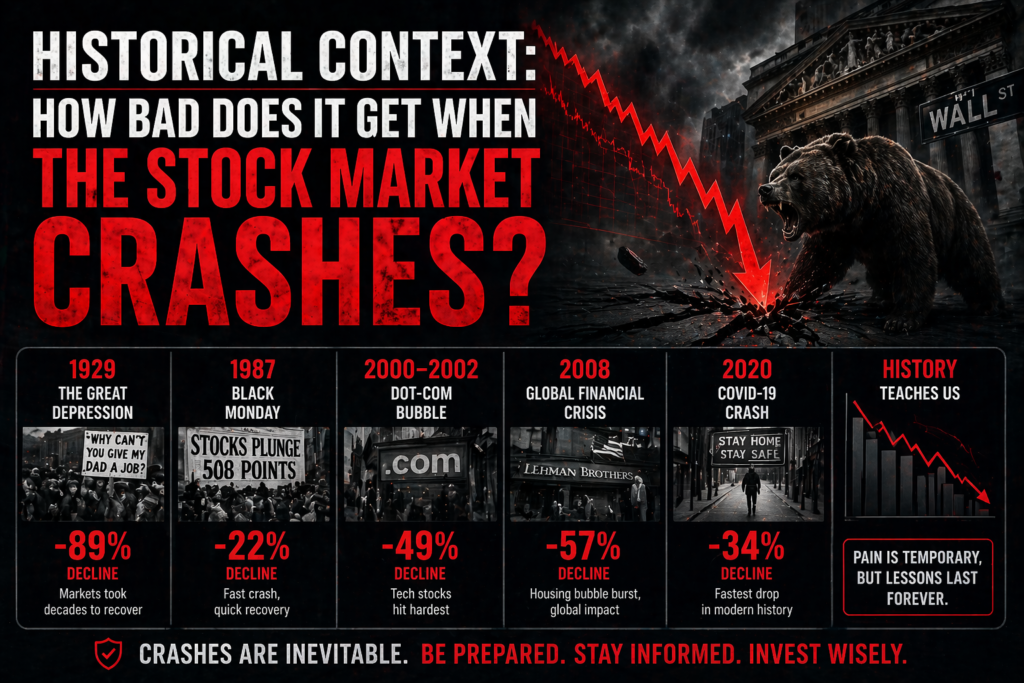
Looking at history is the most grounding exercise when asking will the stock market crash. The data is sobering but it’s also ultimately reassuring.
The S&P 500 has declined by an average of 32% during recessions, meaning the index has typically dropped into a bear market. Importantly, assuming a recession occurs, that is not a recommendation to sell every stock in your portfolio. Over the last 11 recessions since 1950, the market has recovered from every single one and then some. Timing the market is exceptionally difficult, and more often than not, investors sell at the wrong time, locking in losses. The Motley Fool
The S&P 500 has never generated a negative total return over any rolling 20-year period, even through wars and oil crises. Financer
History offers two simultaneous truths: crashes hurt deeply in the short run, and patient, long-term investors have always been rewarded for staying invested.
What the S&P 500 Valuation Tells Us About Future Returns
Torsten Slok, chief economist at Apollo Global Management, says forward P/E multiples around 22 have historically correlated with annual returns below 3% in the next three years. That outcome is particularly plausible in the current environment because sweeping tariffs imposed by President Trump are likely to slow economic growth, according to numerous experts. Nasdaq
This is an important nuance when asking will the stock market crash: the more likely near-term outcome may not be a catastrophic crash, but rather a prolonged period of mediocre returns as valuations slowly normalize what analysts call “grinding lower” rather than “crashing.”
Estimated earnings growth for 2026 exceeds 16%, according to Bloomberg, FactSet, and S&P Capital IQ. This indicates resilient business and consumer spending. Market leadership has expanded beyond a narrow group of large information technology and communication services stocks. U.S. Bank
Strong corporate earnings are genuinely the best argument against a near-term crash. As long as companies keep beating their numbers, the stock market has a fundamental floor beneath it.
Warren Buffett’s Timeless Advice for This Moment
No examination of will the stock market crash is complete without asking what the world’s most celebrated investor thinks and more importantly, what he’s doing.
Warren Buffett admits he cannot predict short-term movements in the stock market, but his contrarian philosophy says investors should be fearful when others are greedy. His famous guidance from the 2008 crisis: “I can’t predict the short-term movements of the stock market.” Under Buffett’s lead, Berkshire Hathaway has been a net seller of stock for three consecutive years meaning the value of stock the company sold exceeded the value of stock it purchased for the last three years, coinciding with a substantial increase in the stock market’s forward price-to-earnings multiple. Nasdaq
Buffett’s actions speak louder than any prediction. Building cash, reducing overvalued positions, and waiting patiently for the right price that’s the playbook. It worked in 1974, 1987, 2002, 2008, and 2020. It will work again.
How to Protect Your Portfolio If the Stock Market Crashes

Whether or not the stock market will crash this year, every serious investor should take steps now to protect their wealth. Here is what financial professionals recommend:
1. Review Your Asset Allocation Make sure the mix of stocks, bonds, and cash in your portfolio genuinely matches your time horizon and risk tolerance. The closer you are to retirement, the less equity risk you can afford to absorb.
2. Build a Cash Buffer The most prudent course of action is to ensure your portfolio consists only of high-conviction stocks you would feel comfortable holding through a steep drawdown. Now is also a good time to build a cash position doing so will allow you to capitalize on any buying opportunities that arise if the stock market falls sharply in the coming months. The Motley Fool
3. Rotate Into Defensive Sectors My preferred strategy in uncertain times is weighting my portfolio towards recession-resistant stocks, such as healthcare, utilities, or consumer staples. These sectors tend to enjoy consistent demand, even during economic downturns. Yahoo!
4. Focus on Quality, Not Momentum Perhaps the best way to protect your portfolio against a recession or a crash is to invest only in high-quality stocks with solid foundations. The healthier the underlying company is, the better its chances of thriving over time despite short-term volatility. The Motley Fool
5. Don’t Try to Time the Market Trying to time the market could easily backfire. Productivity gains from artificial intelligence could offset economic weakness created by tariffs, in which case stocks could avoid a bear market despite high valuations. Yahoo Finance
6. Consider International Diversification Central banks in the rest of the world are leaning more hawkish, while the Fed rate cutting cycle isn’t over. All this together could keep downward pressure on the dollar and boost international stock returns, drawing money away from U.S. assets and into international ones.Charles Schwab.
Read More : Why Is the Crypto Market Down Today? 10 Powerful Reasons You Must Know
Will the Stock Market Crash? A Probability-Based Scenario Framework
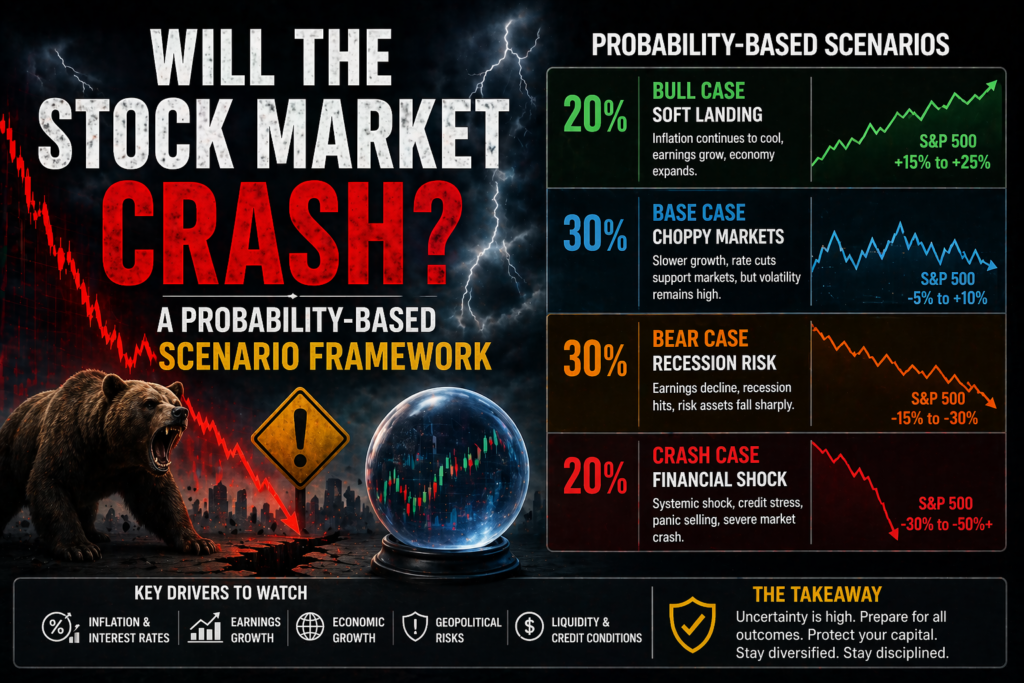
Rather than a single prediction, here is an honest probability framework for what the stock market may do over the remainder of 2026:
Base Case (Most Likely ~50% probability): Mild Correction of 10–20% Tariff headwinds, geopolitical tensions, and elevated valuations combine to produce a choppy, volatile year. The S&P 500 pulls back 10–20% from its highs before stabilizing and recovering toward year-end. No recession, but growth slows noticeably.
Bull Case (~25% probability): Continued Rally The Fed cuts rates, the Iran situation de-escalates, earnings continue to beat expectations, and AI productivity gains offset tariff drag. The S&P 500 pushes toward 7,500–8,000. The bull market extends into a fourth consecutive double-digit year.
Bear Case (~25% probability): Severe Decline of 25–40% The most probable scenario for a severe decline is a correction of 15–30% rather than a catastrophic crash. Historical four-year market cycles suggest stocks could face the most pressure through mid-to-late 2026. Financer In this scenario, the Iran war spreads, oil stays above $120, the U.S. enters a technical recession, and the AI trade collapses. This is painful but historically temporary.
Read More : Why Is Bitcoin Dropping? 10 Real Reasons Behind the 2026 BTC Price Crash
External Resources
For ongoing research and real-time data on whether the stock market will crash, explore these trusted sources:
- U.S. Bank — Is a Market Correction Coming in 2026?
- The Motley Fool — Is a Stock Market Crash Coming in 2026?
- Nasdaq — Will the Stock Market Crash? Warren Buffett’s Advice
- Fortune — The Buffett Indicator Just Hit a Dizzying New High
- U.S. News — Will the Stock Market Crash? 6 Risk Factors
- Charles Schwab — Four Possible Market Pitfalls to Watch in 2026
Will the stock market crash in 2026?
Based on current data, a full catastrophic crash similar to 2008 is not the base case. However, the risk of a significant correction of 15–30% is elevated, given extreme valuations (CAPE ratio near 40, Buffett Indicator above 220%), geopolitical oil shocks from the Iran war, tariff-driven economic headwinds, and a divided Federal Reserve. Most major Wall Street institutions are cautiously optimistic, but preparation is strongly advised.
What are the biggest warning signs that the stock market might crash?
The most significant warning signals right now include: the S&P 500 CAPE ratio near its highest level since the dot-com crash in 2000; the Buffett Indicator above 230% of GDP; Moody’s AI recession model at 49% probability; the VIX fear gauge hovering well above its long-term average; a weakening labor market; surging oil prices; and Warren Buffett’s Berkshire Hathaway being a net seller of equities for three consecutive years.
How bad would a stock market crash be in 2026?
Historically, the S&P 500 declines an average of 32% during recessions. In the more likely “moderate correction” scenario, the index may pull back 15–25% from peak levels. In a severe scenario driven by a confirmed recession, oil shock, and earnings collapse, a 30–40% decline is possible. However, the market has recovered from every single crash in its history and always gone on to set new highs.
Should I sell my stocks before the market crashes?
Most financial experts advise against trying to time the market. Selling requires being right twice — when to get out and when to get back in — and research consistently shows that missing just the 10 best trading days of a decade dramatically reduces long-term returns. Instead, review your allocation, build a cash buffer, and ensure you own high-quality companies you’d be comfortable holding through a drawdown.
Conclusion
So, will the stock market crash? The complete and honest answer in April 2026 is this: a full, catastrophic crash is not the most likely outcome but the conditions for a significant and painful correction are firmly in place, and smart investors are not looking away.
Will the stock market crash because of extreme valuations? The CAPE ratio and Buffett Indicator are both flashing warnings not seen since the dot-com bubble. Will the stock market crash because of tariffs? Federal Reserve researchers say tariffs historically lead to slower growth and higher unemployment neither of which is good for equities. Will the stock market crash because of geopolitical risk? Oil above $120 a barrel and Moody’s recession model approaching 50% say the risk is real. Will the stock market crash because the Fed is divided and confused? When the world’s most powerful central bank doesn’t know whether to raise or cut rates, markets suffer.
None of this means you should panic, liquidate your portfolio, and hide cash under your mattress. The history of the stock market is overwhelmingly a history of long-term resilience. Crashes hurt deeply and temporarily. But they have never been permanent, and they have always created extraordinary buying opportunities for investors who kept their heads while others lost theirs.
Will the stock market crash? It might. It has before, and it will again someday. What separates successful investors from everyone else is not the ability to predict when the next crash will happen, but the discipline to be prepared for it before it does, the courage to stay invested through it when it arrives, and the patience to hold on long enough to capture the recovery that follows.
Review your portfolio today. Build your cash buffer. Own quality. Stay disciplined. And never invest money you cannot afford to have tied up for at least five years.
Because whether or not the stock market crashes in 2026, the long-term trajectory of the market has always been and will always remain upward