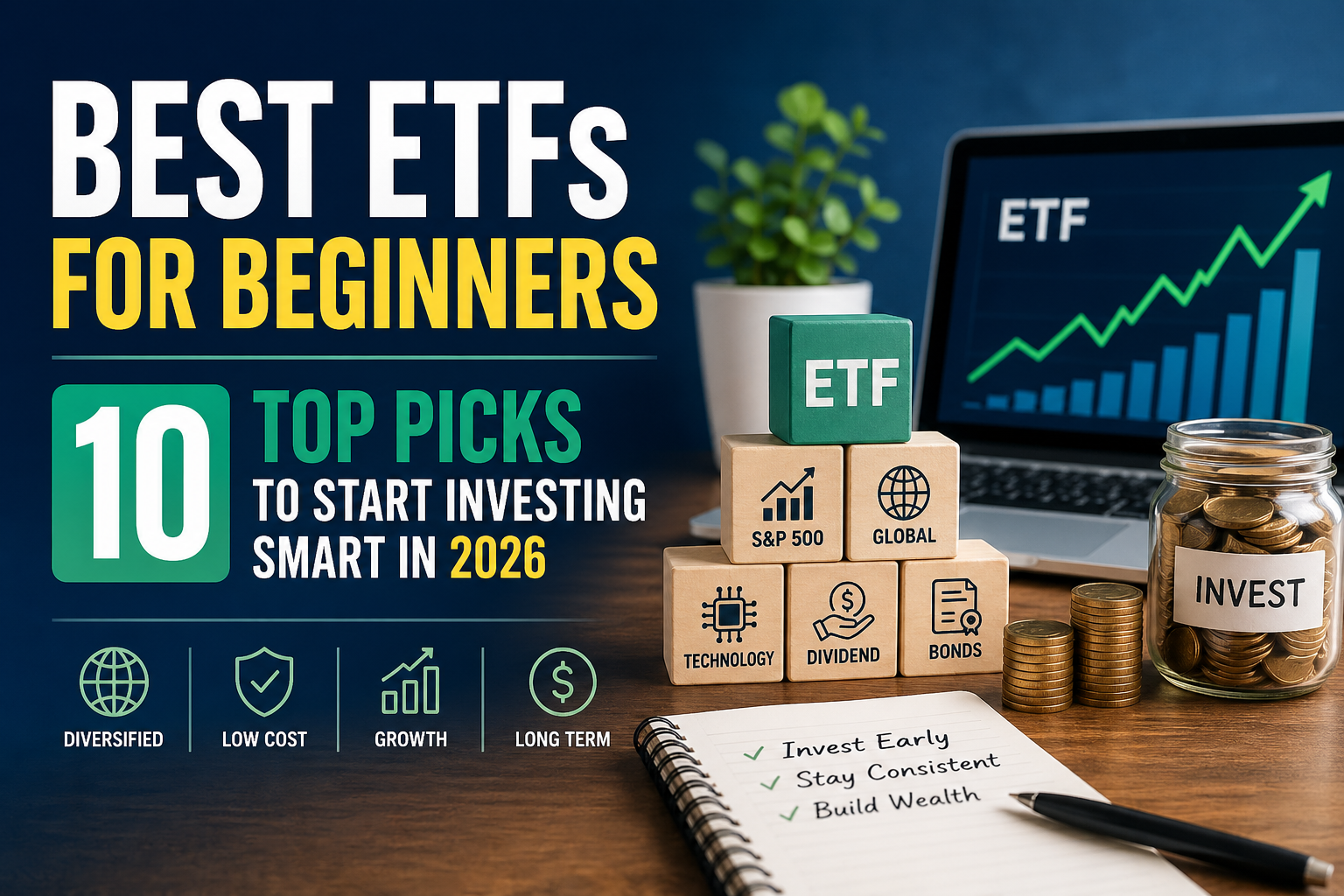
If you are new to investing and trying to figure out where to put your money, you have almost certainly come across the term ETF. And if your next question was what are the best ETFs for beginners? you are in exactly the right place.
The best ETFs for beginners are not complicated hedge fund products reserved for Wall Street professionals. They are simple, affordable, incredibly powerful investment vehicles that allow everyday people to own a slice of hundreds sometimes thousands of companies in a single purchase, for less than the cost of a cup of coffee in annual fees.
In 2026, the best ETFs for beginners matter more than ever. With over 5,000 ETFs now listed on U.S. exchanges, the choice is genuinely overwhelming for newcomers. Should you pick an S&P 500 fund? A total market fund? A tech ETF? A dividend ETF? A bond ETF? The options seem endless, and the wrong choice or analysis paralysis can cost you years of compounding gains.
This guide cuts through all of that noise. We’ve done the research, analyzed the data, and compiled the definitive list of the best ETFs for beginners in 2026 covering everything from expense ratios and performance history to risk levels and who each fund is best suited for.
Let’s build your wealth, one smart ETF at a time.
Table of Contents
What Is an ETF and Why Is It Perfect for Beginners?
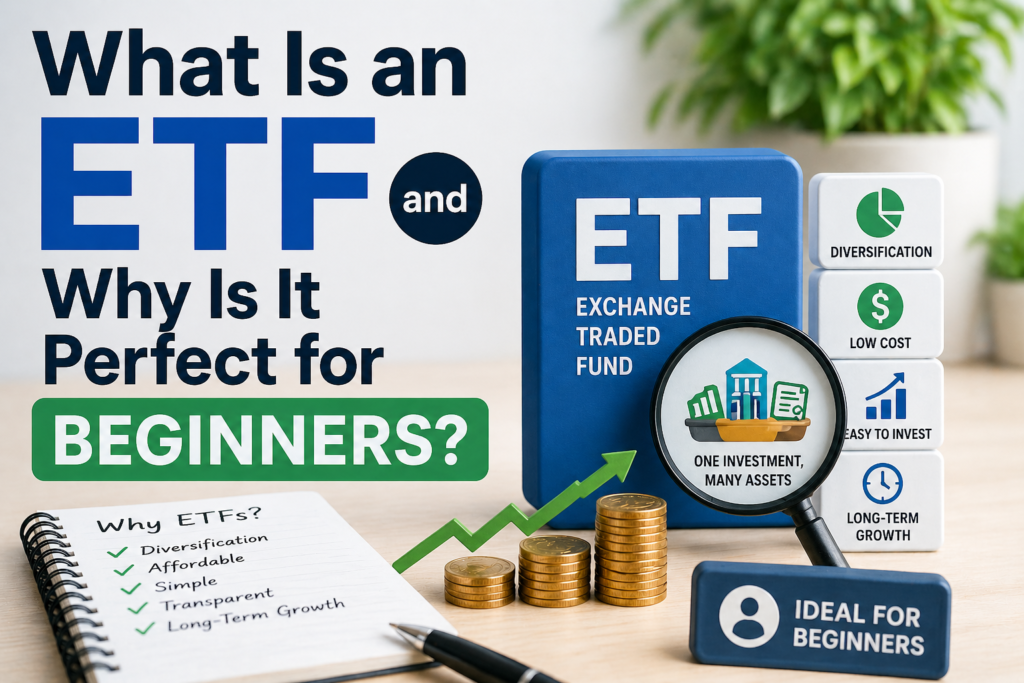
Before we get to the specific best ETFs for beginners, it’s important to understand what an ETF actually is and why financial experts consistently recommend them as the ideal starting point for new investors.
Exchange-traded funds (ETFs) allow investors to buy a collection of stocks or other assets in just one fund with usually low expenses, and they trade on a stock exchange just like individual shares. Rather than trying to pick winning stocks, you could simply buy an index fund and own a piece of many top companies. By investing in many assets sometimes hundreds ETFs provide the benefits of diversification, reducing but not eliminating the risk for investors compared to owning just a handful of assets. One of the big advantages of ETFs is their liquidity, meaning they are easily convertible to cash. Investors can buy and sell their funds on any day the market is open.Rates
In plain terms: instead of betting your money on one or two stocks and hoping they go up, you spread your investment across an entire market or sector through a single, low-cost fund. If one company in the fund has a bad year, dozens of other companies absorb that shock.
ETFs let you invest in hundreds or even thousands of companies at once, helping you reduce risk while keeping costs low. Instead of picking individual stocks, you can own a slice of the entire market with a single ETF. Pantera
The global ETF market experienced unprecedented growth in 2025, surpassing $14 trillion in assets under management with record inflows of over $1.2 trillion across regions. Looking to 2026, analysts forecast continued expansion driven by AI infrastructure spending, the acceleration of the energy transition, and a resurgence in fixed income as yields stabilize around 4%. Gemini
The world’s smartest money is flowing into ETFs. Here is how beginners can access the exact same tools.
What to Look for in the Best ETFs for Beginners
Not all ETFs are created equal, and knowing how to evaluate them is the first real skill every new investor needs. When searching for the best ETFs for beginners, here are the key criteria that matter most:
Expense Ratio This is the annual fee you pay to own the fund, expressed as a percentage of your investment. The lower, the better. For the best ETFs for beginners, aim for expense ratios below 0.20%, and ideally below 0.10%. A fund charging 0.03% versus one charging 0.75% may sound like a small difference, but over 30 years of investing, that gap compounds into tens of thousands of dollars in lost returns.
Assets Under Management (AUM) The total value of money invested in the fund. Larger AUM means better liquidity, tighter bid-ask spreads, and a lower chance of the fund closing down. For each best-in-class pick, ETF analysts emphasize funds with robust assets under management for longevity and scale, and low bid-ask spreads to ensure efficient trading for investors of all sizes.Bitwise Asset Management
Diversification The best ETFs for beginners own a broad range of holdings so that no single company failure can wipe out a large percentage of the fund’s value.
Performance History Past performance never guarantees future results, but a consistent long-term track record across multiple market cycles tells you how a fund performs under real-world conditions.
Benchmark Index The simplest, most reliable best ETFs for beginners track well-established, rules-based indexes like the S&P 500, the total U.S. stock market, or a broad bond market index. They don’t rely on a fund manager’s judgment they simply own what the index owns.
The 10 Best ETFs for Beginners in 2026
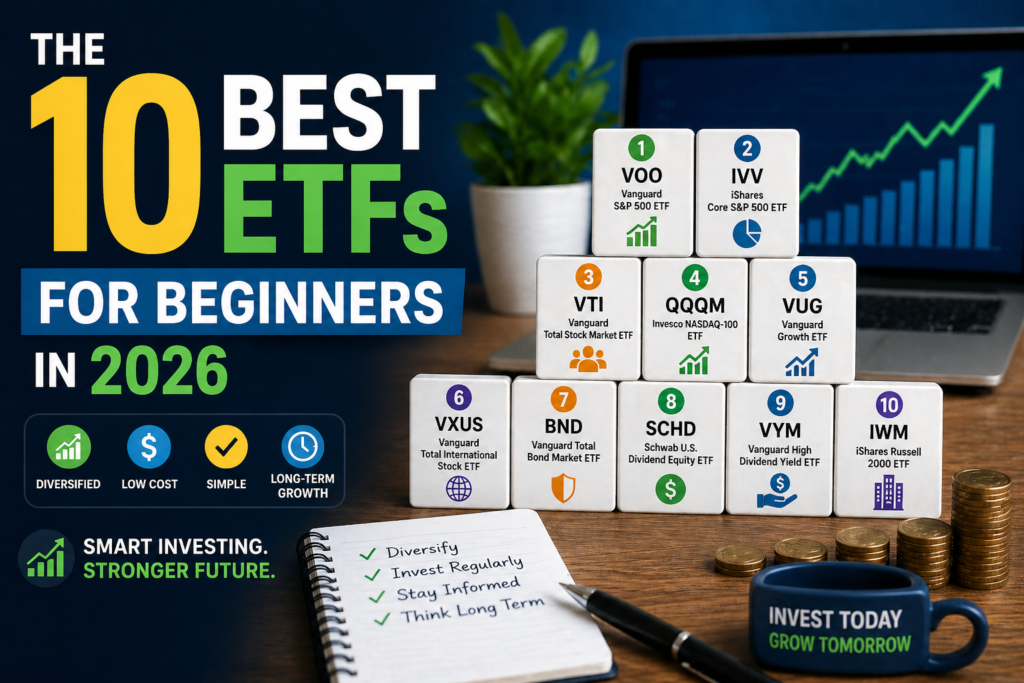
Here are the top ten picks researched, analyzed, and ranked for new investors looking to build lasting wealth.
1. Vanguard S&P 500 ETF (VOO) The #1 Best ETF for Beginners Overall
Ticker: VOO Expense Ratio: 0.03% Assets Under Management: $560 billion 5-Year Return: ~82% (15.80% annualized) Dividend Yield: 1.30% Best For: Every beginner investor
If you only ever buy one ETF in your life, make it VOO. This is the single most recommended fund for beginners by virtually every credible financial institution, analyst, and educator and the data backs it up completely.
Vanguard S&P 500 ETF earns its spot as the best overall pick because it delivers on the metrics that matter most for beginner investors. With an expense ratio of just 0.03%, you keep more of your returns working for you over time. The fund manages $560 billion in total assets, which speaks to its popularity and ensures strong liquidity with tight bid-ask spreads when you buy or sell shares.
Over the past five years, VOO has delivered a total return of 15.80%, outperforming many of its peers and rewarding patient, long-term investors. The fund holds 503 individual securities, giving you exceptional diversification across a wide swath of the market. VOO currently pays a dividend yield of 1.30%, providing investors with a stream of regular income on top of capital appreciation.Silicon Valley Bank
The Vanguard S&P 500 ETF offers an ultra-low expense ratio of just 0.03%, compared to the 0.23% average for similar funds. This lower expense ratio means that for every $10,000 invested in the fund, investors pay just $3 in annual fees versus $23 in a typical competing fund. It was the largest ETF by assets under management in April 2026. The ETF’s combination of low costs and large size makes it an excellent choice for investing in the broader market. Coinbase
Investors who bought $1,000 worth of VOO shares five years ago would now be looking at an investment worth $1,829. Looking at the last ten years, VOO has achieved an annualized return of 14.92%.Unocoin Blog.
VOO is also Warren Buffett’s recommended fund for the vast majority of investors. During a 2020 Berkshire Hathaway annual meeting, he stated that an S&P 500 index fund is the single best investment most people can make and VOO is the gold standard version of that idea. When searching for the best ETFs for beginners, VOO is simply in a class of its own.
2. Vanguard Total Stock Market ETF (VTI) Best for Maximum U.S. Diversification
Ticker: VTI Expense Ratio: 0.03% Assets Under Management: $430 billion Best For: Beginners who want broader U.S. market exposure
VTI gives you exposure to thousands of U.S. companies, from small startups to massive corporations like Apple and Microsoft. If you want a “set it and forget it” ETF, this is one of the best options for 2026. You don’t need to guess which stocks will win VTI owns them all.Pantera
Vanguard Total Stock Market ETF is ideal for investors who want complete U.S. stock market coverage in a single fund. It charges just 0.03% annually with $430 billion in assets.
The key difference between VOO and VTI is simple: VOO tracks the S&P 500 (the 503 largest U.S. companies), while VTI tracks the entire U.S. stock market including small and mid-cap companies. VOO tracks the S&P 500, which includes approximately 500 large-cap U.S. companies, while VTI tracks the entire U.S. stock market including small and mid-cap stocks.
Both have very low expense ratios and perform similarly over time. VTI offers slightly broader diversification, but either is an excellent choice for a beginner.
For practical purposes, VOO and VTI behave almost identically over long periods because the S&P 500 companies represent roughly 80% of VTI’s total weight anyway. If forced to choose, beginners who want the absolute broadest possible diversification with zero extra cost should pick VTI. Those who want to align with the most widely tracked benchmark in the world should pick VOO. Either way, you cannot go wrong.
3. Invesco QQQ Trust (QQQ) Best ETF for Beginners Seeking Growth
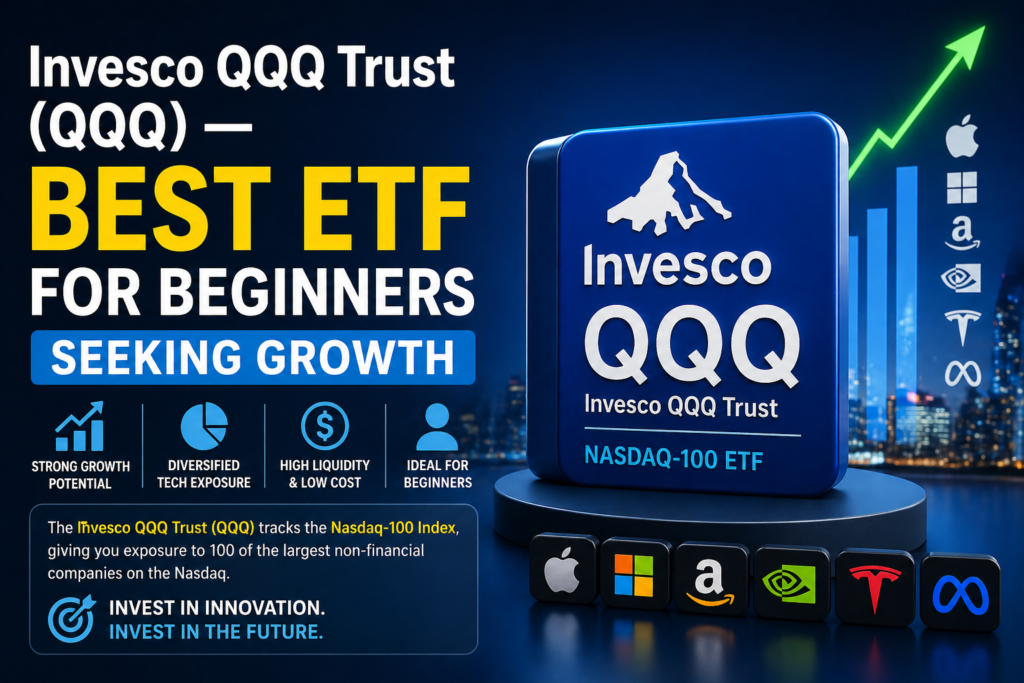
Ticker: QQQ Expense Ratio: 0.18% Assets Under Management: $395 billion 10-Year Return: ~538% Best For: Beginners comfortable with higher volatility seeking long-term growth
If VOO is the safe, dependable foundation of any beginner portfolio, QQQ is the turbo-charged engine that serious long-term growth investors add on top.
As one of the best-performing ETFs, Invesco QQQ Trust boasts an affordable expense ratio of 0.18%. As of April 2026, the Invesco QQQ Trust had generated a total return of around 538% over the past decade.
A $10,000 investment made in this ETF ten years ago would be worth more than $63,770 today. The Nasdaq-100’s focus on innovative technology companies positions it to continue delivering strong total returns, especially as artificial intelligence accelerates growth in the tech sector.Coinbase
Invesco QQQ Trust tracks the 100 largest non-financial companies listed on the Nasdaq, which in practice means owning the most dominant growth businesses in the world. Information technology makes up nearly 49% of the fund, with Communication Services adding another 16%. The result is a portfolio built almost entirely around companies driving economic growth
. Over the past decade, QQQ has returned 459% with an expense ratio of just 0.18%, reasonable for a fund with $395 billion in assets and institutional-grade liquidity.CNBC
The top holdings include Nvidia (approximately 9%), Apple (7.5%), and Microsoft (5.9%). The one honest caveat for beginners: QQQ allocates half of its portfolio to technology stocks, higher than VOO’s 30%. This presents elevated concentration risk for QQQ investors holdings that share similar characteristics don’t do a good job diversifying risk.
Long-term QQQ investors have enjoyed strong past returns, but those unable to stomach sharp drawdowns or high volatility may want to look elsewhere.
The verdict: QQQ belongs in the best ETFs for beginners list, but only as a complement to a broader fund like VOO or VTI not as a standalone portfolio.
Read More : Will the Stock Market Crash? Expert Warnings, Risk Factors & What to Do in 2026
4. Schwab U.S. Dividend Equity ETF (SCHD) Best Dividend ETF for Beginners
Ticker: SCHD Expense Ratio: 0.06% Assets Under Management: $60+ billion Dividend Yield: ~3.5% Best For: Beginners seeking income alongside growth, especially those closer to retirement
SCHD is the dividend investor’s dream ETF and belongs on every list of the best ETFs for beginners who want their money to work for them in two ways simultaneously: capital appreciation and regular cash dividends.
Dividend stocks are great long-term investments. Over the last 50 years, dividend-paying companies outperformed non-dividend payers by more than 2-to-1, with a 9.2% average annual total return versus 4.3% for non-dividend payers.
The best performance came from dividend growers and initiators at 10.2% versus 6.8% for companies with no change in their dividend policy. The Schwab U.S. Dividend Equity ETF provides exposure to high-yielding U.S. stocks with a history of growing their dividends per share.Coinbase
SCHD selects companies based on strict dividend quality criteria: at minimum 10 consecutive years of dividend payments, strong cash flow coverage of dividends, above-average dividend yield, and strong earnings growth. This filters out “dividend traps” companies that pay high dividends but have weak underlying businesses.
SCHD charges just 0.06% for dividend-focused exposure that other funds charge far more for. There is no reason to pay more when SCHD delivers high-quality dividend exposure at this price.
For beginners who want passive income from their investments quarterly cash deposits into their brokerage account without doing anything SCHD is one of the best ETFs for beginners to accomplish exactly that goal.
5. SPDR S&P 500 ETF Trust (SPY) Best for Beginners Who Want Maximum Liquidity
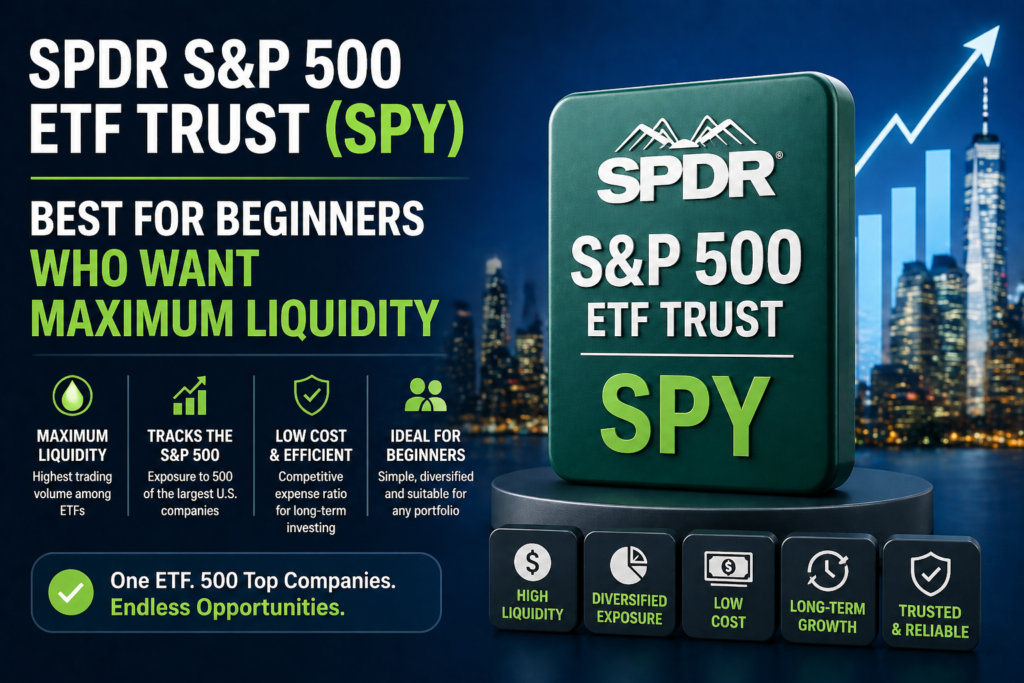
Ticker: SPY Expense Ratio: 0.0945% Assets Under Management: $600 billion Best For: Beginners who prioritize the ability to buy and sell quickly with minimal price impact
SPY was the very first ETF ever listed in the United States. The SPDR S&P 500 Trust launched on January 22, 1996, and kicked off the modern exchange-traded fund era. Bitwise Asset Management It remains the single largest ETF in the world by assets under management at $600 billion.
SPY tracks the same S&P 500 index as VOO, but with one key difference: it charges 0.0945% annually, which is higher than VOO’s 0.03%. For long-term buy-and-hold investors, VOO is mathematically the better choice. However, SPY has the highest daily trading volume of any ETF on earth,
which means its bid-ask spreads are exceptionally tight. For beginners who are learning to trade and want the most liquid, actively traded version of an S&P 500 fund, SPY is the industry benchmark.
Most financial advisors recommend VOO over SPY for pure buy-and-hold beginners due to the lower cost. But SPY’s status as the world’s most traded ETF means it belongs in any discussion of the best ETFs for beginners.
6. Vanguard Total Bond Market ETF (BND) Best Bond ETF for Beginners
Ticker: BND Expense Ratio: 0.03% Assets Under Management: $116 billion Dividend Yield: ~4.0% Best For: Conservative beginners or those building a balanced portfolio
Every well-built beginner portfolio needs some bond exposure and BND is the single best, lowest-cost way to get it.
Vanguard Total Bond Market ETF is ideal for conservative investors who want portfolio stability and predictable income. It charges just 0.03% annually with $116 billion in assets.
Bonds and stocks tend to move in opposite directions during periods of economic stress. When the stock market falls sharply, bond prices often rise, cushioning your portfolio from the full force of the decline. By owning both BND and a stock ETF like VOO or VTI, beginners create a naturally balanced portfolio that delivers growth during good times and protection during bad times.
BND holds thousands of U.S. investment-grade bonds including Treasury bonds, corporate bonds, and mortgage-backed securities. Its ultra-low 0.03% expense ratio means you keep virtually all the yield the bonds generate for yourself.
The general rule of thumb for how much BND to hold: subtract your age from 110 to get your ideal stock allocation, and put the remainder in BND. A 25-year-old might hold 85% stocks and 15% bonds. A 55-year-old might hold 55% stocks and 45% bonds. This rebalancing formula automatically makes your portfolio more conservative as you approach retirement exactly when you need it most.
7. Vanguard Total World Stock ETF (VT) Best Single-Fund Global Portfolio for Beginners
Ticker: VT Expense Ratio: 0.07% Assets Under Management: $45+ billion Best For: Beginners who want true global diversification in one fund
VT offers one of the strongest value propositions in the equity ETF space. For $6 per $10,000 invested, you gain exposure to 10,000 stocks that represent the global stock market. Its benchmark, the FTSE Global All Cap Index, spans U.S. stocks, international developed markets, emerging markets, and the full market-cap spectrum across all 11 sectors. VT is the ultimate buy-and-hold ETF for hands-off investors.
The United States makes up roughly 60% of global stock market capitalization, which means a purely U.S.-focused fund like VOO or VTI is essentially ignoring 40% of the investable universe. VT solves that problem in a single purchase.
For the beginner investor who wants the simplest possible portfolio and genuinely does not want to think about rebalancing, sector allocation, or geographic exposure ever again, VT is the answer. Buy it. Add to it regularly. Forget about it for 30 years. This is the essence of what makes it one of the best ETFs for beginners who value radical simplicity.
Read More : When Crypto Market Will Go Up : Expert Predictions & Recovery Timeline 2026
8. Vanguard Growth ETF (VUG) Best Growth ETF for Beginners Beyond QQQ
Ticker: VUG Expense Ratio: 0.04% Assets Under Management: $200+ billion 5-Year Return: ~81% Best For: Growth-oriented beginners who want lower volatility than QQQ
VUG is the quieter, more diversified cousin of QQQ and in many ways, the smarter growth choice for beginners who want technology and growth company exposure without the extreme concentration risk that comes with QQQ.
Vanguard Growth ETF charges just 0.03% while screening across all major U.S. exchanges to add diversification through Eli Lilly, Visa, and Mastercard, alongside technology holdings. It returned 81% over five years. VUG adds diversification through major pharmaceutical and payments companies that do not fit the traditional tech-growth narrative. CNBC
VUG tracks the CRSP U.S. Large Cap Growth Index, which includes large-cap U.S. companies that score highly on growth metrics like earnings growth rate, book value growth, and sales growth. Technology still makes up the largest sector at approximately 50% of the fund, but healthcare, financials, and consumer discretionary companies provide meaningful diversification that QQQ simply doesn’t offer.
At 0.04% expense ratio, VUG is also dramatically cheaper than QQQ’s 0.18%. For beginners focused on the best ETFs for beginners in the growth category, VUG deserves serious consideration as a slightly safer alternative to QQQ.
9. iShares Core S&P Small-Cap ETF (IJR) Best Small-Cap ETF for Beginners
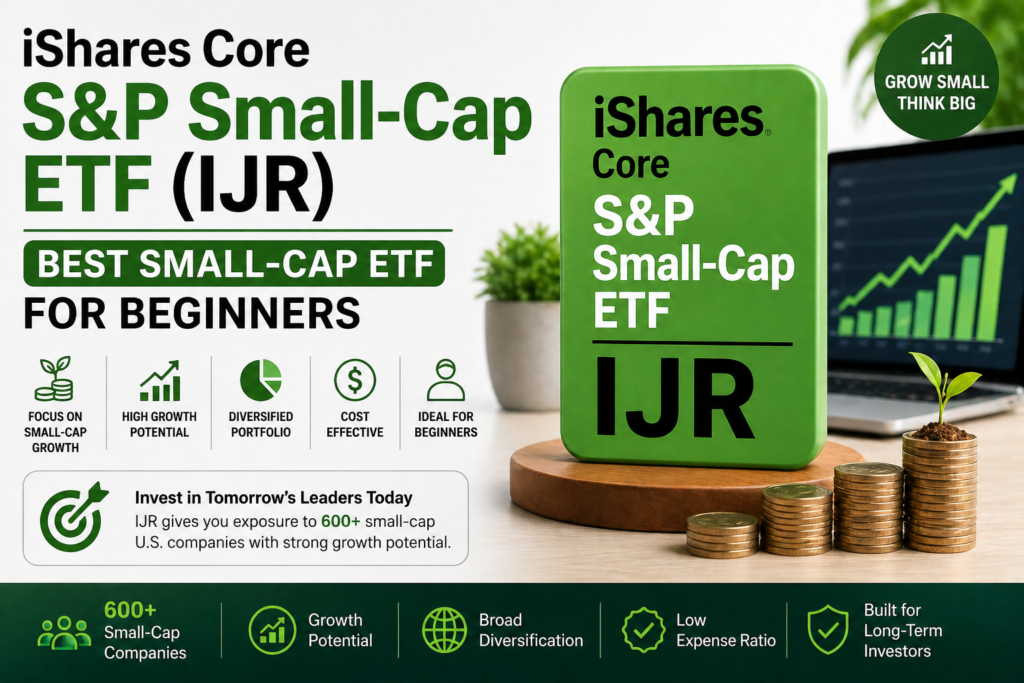
Ticker: IJR Expense Ratio: 0.06% Assets Under Management: $80+ billion Best For: Beginners looking to add higher-growth small-cap exposure
Small-cap stocks companies with market capitalizations generally between $300 million and $2 billion have historically outperformed large-cap stocks over very long time periods. They are more volatile in the short run, but for young investors with decades ahead of them, that volatility is a feature, not a bug.
This ETF helps mute some of that risk by holding a large basket of small-cap stocks. As of April 2026, it held nearly 650 stocks and had a fairly low concentration of holdings. Its top 10 holdings made less than 6% of the total. The ETF has a very low expense ratio of 0.06%, making it a low-cost way to add some small-cap exposure to your portfolio.
IJR is not a standalone portfolio for beginners it is best used as a complement to VOO or VTI, adding a 10–15% small-cap tilt to improve long-term diversification. For beginners with a 20+ year time horizon, adding IJR to a core S&P 500 or total market position has historically produced meaningfully higher long-term returns at the cost of somewhat higher short-term volatility.
10. iShares Core U.S. Aggregate Bond ETF (AGG) Best Bond Alternative to BND
Ticker: AGG Expense Ratio: 0.03% Assets Under Management: $110 billion Dividend Yield: ~3.8% Best For: Conservative beginners seeking portfolio stability and predictable income
iShares Core U.S. Aggregate Bond ETF is the anchor bond holding with $110 billion AUM, 0.03% expense ratio, and a 3.8% yield across the full spectrum of U.S. investment-grade bonds.
AGG and BND are nearly identical in what they own and what they cost. Both track the broad U.S. investment-grade bond market, both charge 0.03% annually, and both serve as excellent portfolio stabilizers for beginner investors. The choice between them often comes down to which brokerage you use Vanguard users tend toward BND while iShares users (Fidelity, Schwab, etc.) prefer AGG.
Either one belongs in any diversified beginner portfolio alongside a stock-focused ETF like VOO or VTI.
Quick Comparison: Best ETFs for Beginners at a Glance
| ETF | Ticker | Expense Ratio | AUM | Best For |
| Vanguard S&P 500 ETF | VOO | 0.03% | $560B | Best overall pick |
| Vanguard Total Stock Market | VTI | 0.03% | $430B | Broadest U.S. coverage |
| Invesco QQQ Trust | QQQ | 0.18% | $395B | Technology & growth |
| Schwab U.S. Dividend Equity | SCHD | 0.06% | $60B+ | Dividend income |
| SPDR S&P 500 Trust | SPY | 0.09% | $600B | Maximum liquidity |
| Vanguard Total Bond Market | BND | 0.03% | $116B | Conservative/balanced |
| Vanguard Total World Stock | VT | 0.07% | $45B+ | Global diversification |
| Vanguard Growth ETF | VUG | 0.04% | $200B+ | Diversified growth |
| iShares Small-Cap ETF | IJR | 0.06% | $80B+ | Small-cap exposure |
| iShares U.S. Aggregate Bond | AGG | 0.03% | $110B | Portfolio stability |
Read More : Why Is the Crypto Market Down Today? 10 Powerful Reasons You Must Know
How to Build a Simple Beginner ETF Portfolio in 2026
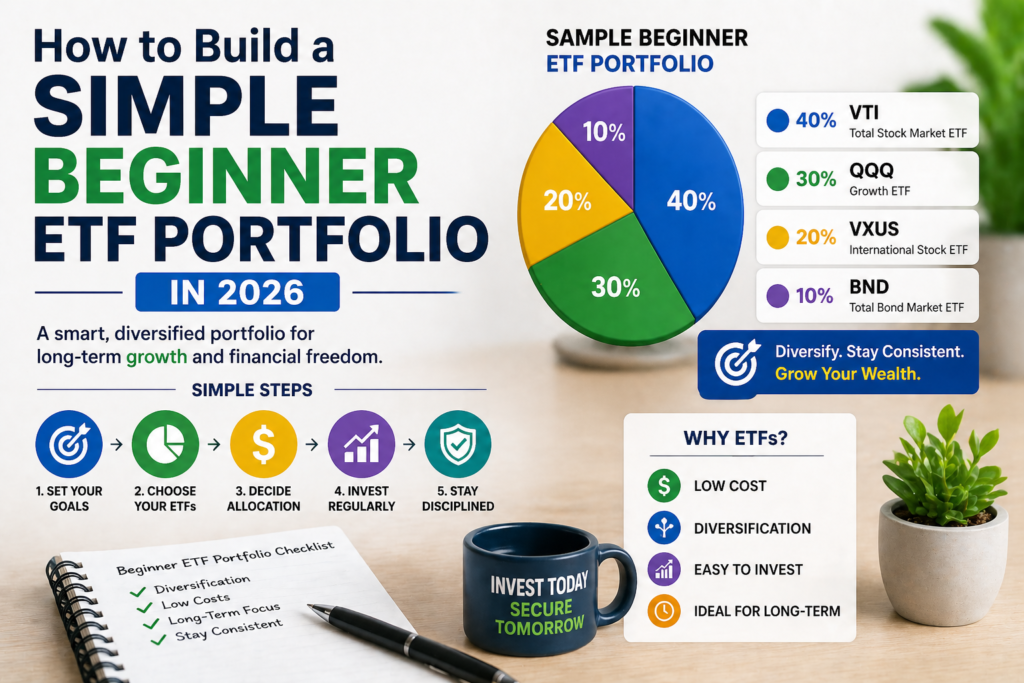
Knowing the best ETFs for beginners is only the first step. Building a coherent portfolio with them is where the real work happens. Here are three simple portfolio templates based on different investor profiles:
The One-Fund Portfolio (Absolute Beginners)
- 100% VOO or VTI
If you are brand new and don’t want to overthink anything, a single investment in VOO or VTI is a perfectly legitimate, academically sound, long-term strategy. A single total market ETF like VTI can give you exposure to the entire U.S. stock market, making it a perfectly valid one-fund portfolio for beginners. Simplicity is an advantage when you are just starting out.
The Classic Two-Fund Portfolio (Balanced Beginners)
- 80% VOO or VTI
- 20% BND or AGG
Adding bond exposure with BND or AGG reduces portfolio volatility while still capturing most of the stock market’s long-term growth. This is ideal for beginners who get nervous watching their portfolio swing 20% in either direction.
The Growth-Oriented Three-Fund Portfolio (Young, Long-Term Beginners)
- 60% VOO or VTI
- 20% QQQ or VUG
- 20% VT
This portfolio captures broad U.S. market exposure, adds a tilt toward growth and technology, and includes international diversification all with minimal costs and effortless rebalancing.
Common Mistakes Beginners Make When Buying ETFs
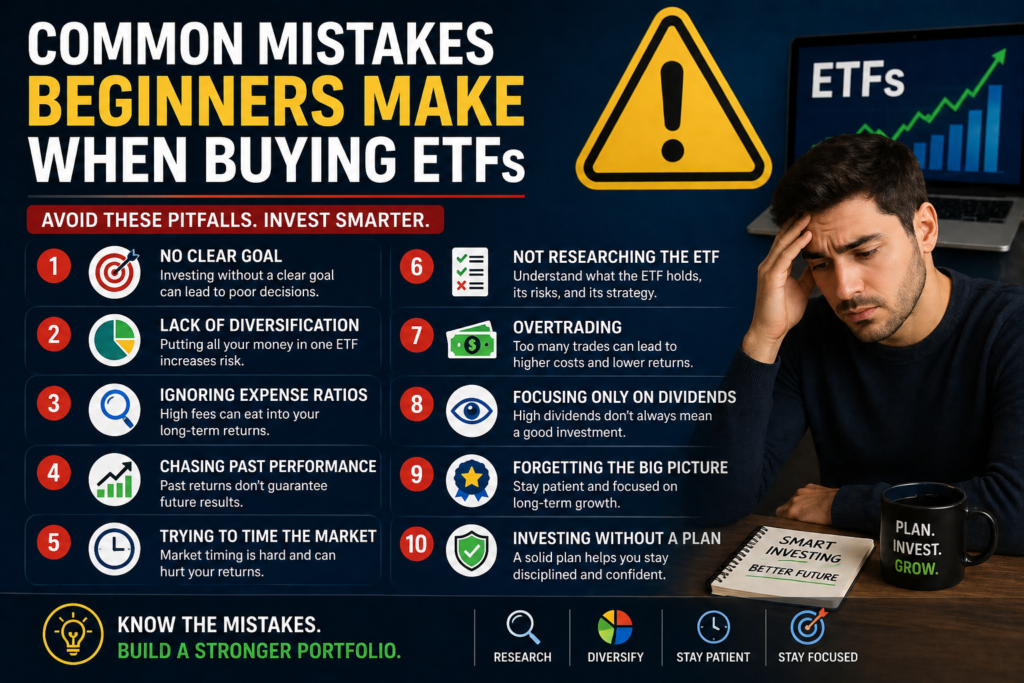
Even armed with knowledge of the best ETFs for beginners, new investors consistently make avoidable errors. Here is what to watch out for:
Mistake 1: Overcomplicating the portfolio Even with a solid selection of ETFs, investors in the beginners category can undermine their results by falling into avoidable traps. Overcomplicating a portfolio with too many overlapping ETFs when one or two broad funds suffice is one of the most common and costly mistakes. Silicon Valley Bank
Mistake 2: Chasing last year’s top performer The ETF that returned 400% last year is rarely the ETF that returns 400% next year. Discipline and consistency beat performance-chasing every single time over the long run.
Mistake 3: Ignoring the expense ratio There is no reason to pay more for the same exposure. When two ETFs track the same index, the one with the lower expense ratio will always outperform the other over time. The only logical choice is the cheaper fund.
Mistake 4: Checking your portfolio too often Checking your portfolio once a month or once a quarter is sufficient for most beginners. Frequent monitoring can lead to emotional decisions and unnecessary trading.
Mistake 5: Stopping contributions during market downturns Market pullbacks are when the best ETFs for beginners are on sale. Stopping your regular contributions during fear is the single most reliable way to underperform the market over time. The best investors buy more not less when markets fall.
External Resources
For deeper research on the best ETFs for beginners, explore these trusted sources:
- Bankrate — Best ETFs for 2026 by Category
- The Motley Fool — 7 Best ETFs to Buy in April 2026
- Kiplinger — The Best ETFs to Buy for 2026 and Beyond
- Morningstar — 3 Mistakes to Avoid When Choosing an ETF
- My ETF Journey — Best ETFs for Beginners in 2026 (Full Comparison)
- ETF.com — Best Performing ETFs of 2026
What is the single best ETF for a complete beginner?
The single best ETF for a complete beginner is the Vanguard S&P 500 ETF (VOO). It has a 0.03% expense ratio one of the lowest in the industry $560 billion in assets, 503 diversified holdings, a 15.80% five-year annualized return, and the backing of Warren Buffett’s personal recommendation. If you only ever buy one ETF in your investing life, VOO is the answer.
How much money do I need to start investing in ETFs?
Most major ETFs trade like stocks, meaning you can buy as little as one share. With fractional share investing now available at most major brokerages including Fidelity, Charles Schwab, and Robinhood you can start investing in the best ETFs for beginners with as little as $1. There is genuinely no minimum investment barrier to entry in 2026
Are ETFs safer than individual stocks for beginners?
Yes, in the sense that ETFs provide instant diversification across hundreds or thousands of companies, while an individual stock represents a single company that could decline 50–100% if things go wrong. An ETF tracking 503 companies is never going to go to zero. However, ETFs are still subject to market risk during broad market downturns, even the best ETFs for beginners will lose value temporarily.
What is the difference between VOO, VTI, and SPY?
All three track the broad U.S. large-cap stock market. VOO and SPY both track the S&P 500 index (503 largest U.S. companies), but VOO charges 0.03% versus SPY’s 0.0945% making VOO the better long-term buy-and-hold choice. VTI tracks the entire U.S. stock market including small and mid-cap stocks, offering broader diversification at the same 0.03% cost. For long-term beginners, VOO or VTI is the better choice over SPY due to lower fees.
Conclusion
The best ETFs for beginners in 2026 are not secrets held by professional fund managers on Wall Street. They are simple, transparent, low-cost index funds available to anyone with a smartphone and a brokerage account and they have consistently created more wealth for everyday investors than almost any other investment strategy in history.
The best ETFs for beginners VOO, VTI, QQQ, SCHD, BND, VT, VUG, IJR, SPY, and AGG give you instant diversification, ultra-low fees, and exposure to the most powerful economic forces driving long-term wealth creation. Whether you are a 22-year-old just opening your first brokerage account or a 45-year-old who has been putting off investing for too long, the best ETFs for beginners meet you wherever you are and build the foundation for real, lasting financial independence.
The best ETFs for beginners do not require you to predict which stock will win, which sector will boom, or which CEO will make the right decisions. They simply ask you to own a piece of the entire market, keep your costs low, reinvest your dividends, and stay invested through the inevitable downturns that every market cycle brings.
Start with one fund. Start small if that’s all you can manage. Add to it every month without fail. Let compounding do the heavy lifting. And trust the process because the best ETFs for beginners have delivered extraordinary results for patient investors in every decade they have existed, and there is every reason to believe they will continue to do so.
The best time to start investing in ETFs was ten years ago. The second-best time is today.