
Have you heard people talking about the AI bubble and wondering what it actually means? You are not alone. In 2026, this word AI bubble is everywhere. On news channels, in business meetings, and on social media. But most articles are too hard to understand.
In this simple guide, we will explain what is AI bubble in very easy English. We will also tell you why it matters, what the signs are, and whether it will burst. Let us start from the beginning.
Table of Contents
What is AI Bubble?
A bubble in business means when the price of something goes very high much higher than its real value. This happened with internet companies in the year 2000. That was called the Dot-com Bubble. It happened again with house prices in 2008. Now, many experts say the same thing is happening with Artificial Intelligence (AI) companies.
So, what is AI bubble? It is a situation where investors are putting too much money into AI companies, AI tools, and AI technology often without checking if these companies are actually making real profits. The value of these companies goes up very fast on paper, but the actual earnings do not match.
Think of it like blowing a balloon. You can blow more and more air and it gets bigger. But at some point, if you keep blowing, the balloon will burst. The AI bubble works the same way.
Why Are People Talking About the AI Bubble in 2026?
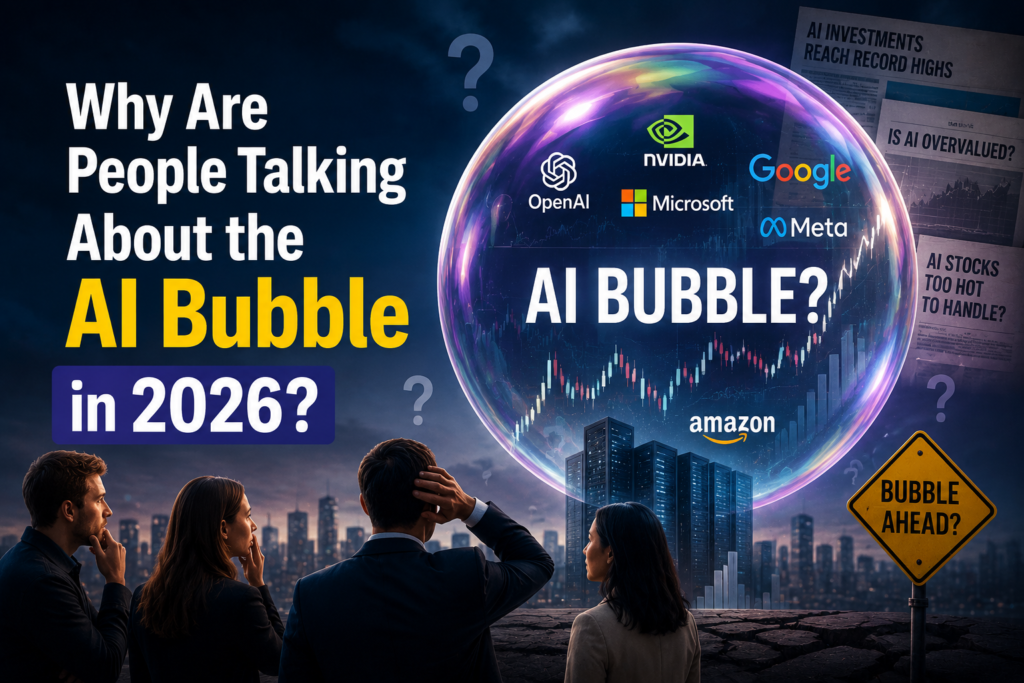
The AI industry has grown at a very fast speed since 2022. Tools like ChatGPT, Gemini, and Midjourney became extremely popular overnight. Big companies like Microsoft, Google, Meta, and Amazon started spending billions of dollars on AI research and AI infrastructure.
Here is what happened in recent years:
- Nvidia, an AI chip company, became one of the most valuable companies in the world
- Hundreds of AI startups raised billions of dollars without showing clear profits
- Many businesses started using AI just because it was trending, not because they actually needed it
- Stock prices of AI-related companies kept going up at a very fast pace
- Everyone started talking about AI as if it would solve every problem in the world overnight
All of this created a huge wave of excitement and investment. But experts started asking is all this money going into something real? Or is it just hype? This is exactly what the AI bubble debate is all about.
Read More : Commodities Natural Market 2026: Complete Guide to Types, Trends & How to Invest
What Are the Main Signs of the AI Bubble?
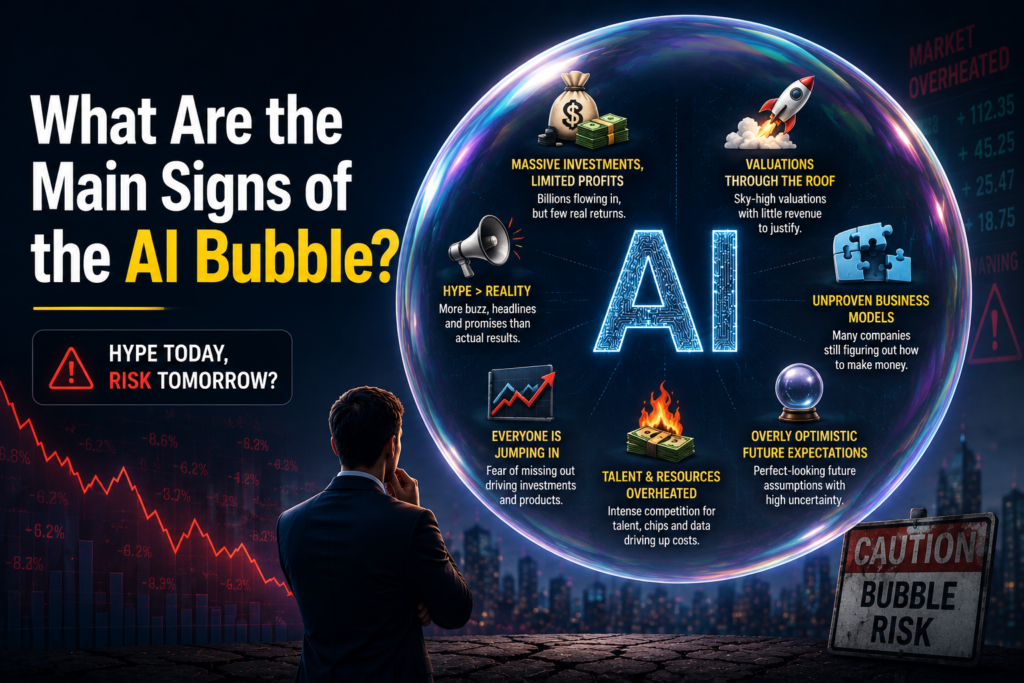
When we talk about what is AI bubble, it helps to look at the warning signs. Here are the top signs that financial experts and tech analysts point out:
1. Overvalued Companies
Many AI companies are valued at billions of dollars even though they are not making much money yet. Investors are paying a very high price for future hopes, not current profits. This is one of the biggest signs of an AI bubble.
2. Too Much Investment Without Returns
Billions of dollars are going into building AI data centers, AI chips, and AI models. But many businesses using AI tools are not seeing clear financial returns yet. When investment is far greater than actual earnings, it is a classic bubble sign.
3. Fear of Missing Out (FOMO)
Many investors and companies are joining the AI race just because they are afraid of being left behind. This kind of emotional investing not logical investing is another strong sign that the AI bubble may be real.
4. Hype Without Real Use Cases
Yes, AI has many great uses. But there is also a lot of overpromising. Some companies say AI will completely replace doctors, lawyers, and teachers very soon. These big claims are driving investment based on emotion, not facts.
5. Rising Energy and Infrastructure Costs
AI models need huge amounts of electricity and computing power to train and run. These costs are rising fast. If companies cannot cover these costs with real revenues, the AI bubble could burst sooner than expected.
Read More : What Is Intraday Trading? A Complete Beginner’s Guide (2026)
Is the AI Bubble Real? What Do Experts Say?
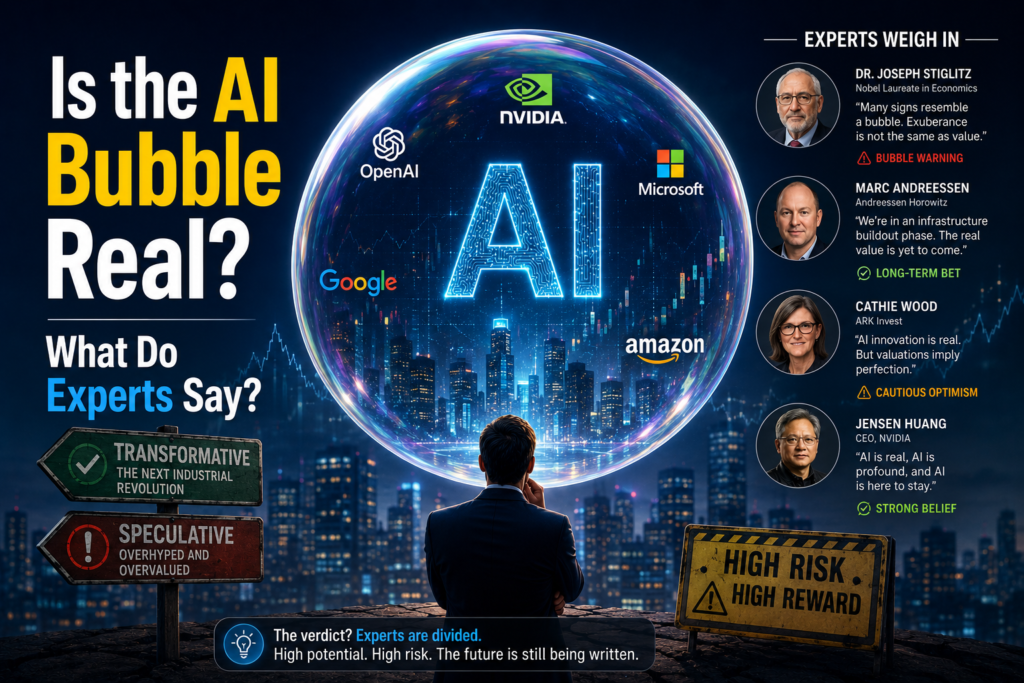
Experts are divided on this topic. Some say the AI bubble is very real and will burst soon. Others say AI is different from past bubbles because it has actual, practical uses.
Those who believe the AI bubble is real say:
- Most AI companies are not profitable yet
- The technology is growing faster than actual business adoption
- Stock market valuations of AI firms seem completely unrealistic
Those who say AI is NOT a bubble argue:
- AI is already being used in hospitals, finance, education, and more
- Big companies like Google and Microsoft are genuinely earning from AI
- The productivity gains from AI are real and measurable
For more expert views on the AI bubble debate, you can read the detailed breakdown on Investopedia — Understanding Economic Bubbles.
AI Bubble vs Dot-Com Bubble: What is the Difference?
To better understand what is AI bubble, let us compare it with the famous Dot-com Bubble of the late 1990s.
Dot-com Bubble: In the 1990s, investors poured money into internet companies. Most had no real business model. In 2000, the bubble burst and millions of people lost their money.
AI Bubble: Today, investors are putting massive amounts into AI companies. Some of these companies do have real products and real customers. But many are still burning cash without showing any profits.
The key difference is that some AI use cases are genuinely transformative. AI in healthcare, education, and logistics is already working well. However, the level of investment and the speed of stock price increases in many AI companies look very similar to what we saw in the Dot-com era.
You can learn more about the Dot-com crash and its lessons on History.com — The Dot-com Bubble Burst.
Will the AI Bubble Burst in 2026?
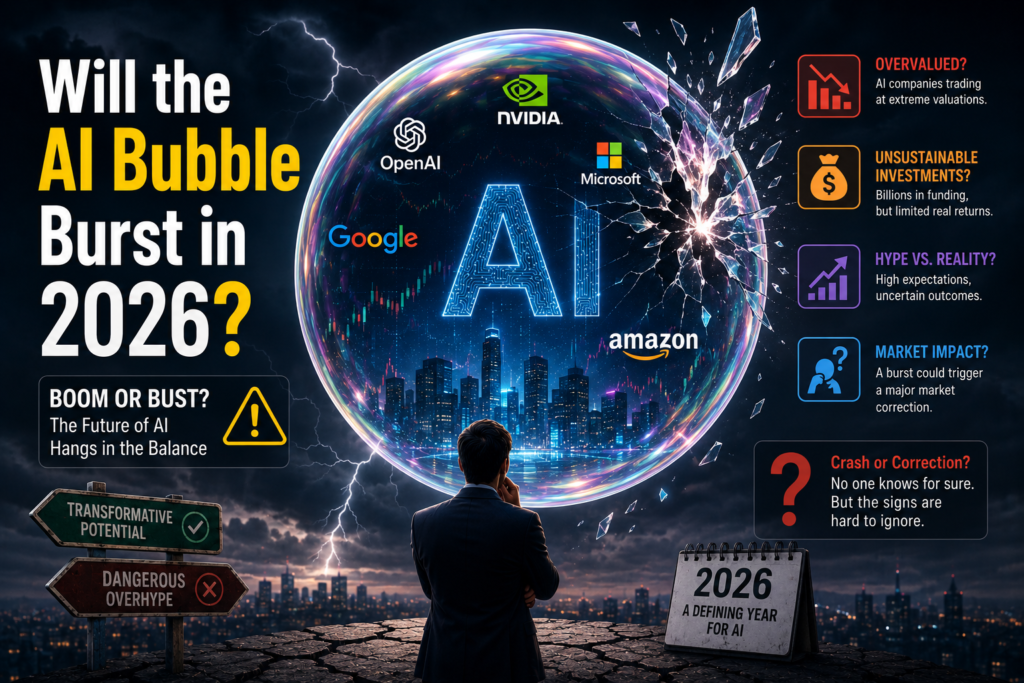
This is the question everyone wants answered. Nobody can say for sure. But here is what the current situation looks like in 2026.
Factors that could burst the AI bubble:
- If major AI companies fail to show profits in 2026, investor confidence could drop sharply
- Rising interest rates make risky tech investments less attractive
- If a cheaper AI model from a competitor disrupts the market like DeepSeek did in early 2025 big AI companies can lose value very fast
- Government regulations on AI could slow down growth significantly
Factors that could prevent the AI bubble from bursting:
- Big tech companies are showing real AI-driven revenue growth right now
- Enterprises are adopting AI tools at scale, creating stable and ongoing demand
- AI chips and infrastructure spending is tied to real data center needs, not just pure speculation
Most experts believe we will not see a complete crash. Instead, a market correction is more likely where overvalued AI companies will drop in price, but the strong ones with real products will survive and keep growing.
Read More : Is Crypto Legal in India? Full Guide 2026 | Rules & Laws Explained
How Does the AI Bubble Affect Common People?
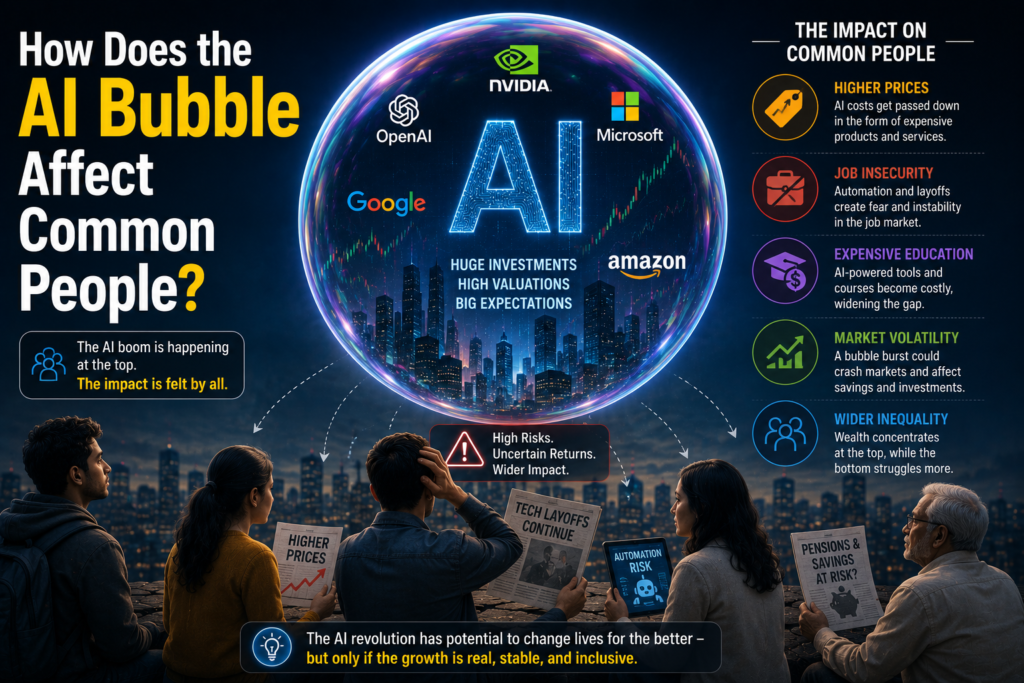
You might think I am not an investor, so why should I care about the AI bubble? Here is why it matters for everyone:
Jobs: If the AI bubble bursts, many tech companies could lay off workers just like they did in 2022 and 2023.
Savings and Investments: If you have money in stocks or mutual funds that include AI companies, a bubble burst could reduce the value of your savings.
Technology Access: If AI companies lose funding, some AI tools and services you use every day may shut down or become expensive.
Economy: A big crash in the tech sector always has ripple effects across the whole economy not just for investors.
What Should You Do About the AI Bubble?
Here is some simple, practical advice for 2026:
- Do not invest blindly in AI stocks just because everyone else is doing it. Always do your own research first.
- Diversify your investments. Do not put all your money in AI-related assets.
- Keep learning about AI so you can take advantage of the real opportunities it offers.
- If you work in tech, keep updating your skills so you stay valuable no matter what happens to the market.
- Follow trusted financial news sources to stay updated on the latest AI market developments.
What is AI bubble in simple words?
The AI bubble means a situation where AI companies are valued much higher than what they are actually worth. Investors are spending huge amounts hoping for big future profits, but many companies are not yet profitable. When this gap between expectations and reality becomes too large, the bubble can burst.
Is the AI bubble going to burst in 2026?
There is no clear answer. Most analysts believe a complete crash is unlikely, but a market correction . where AI stocks lose some of their inflated value is quite possible in 2026. Companies with real products and revenues will survive. Ones built only on hype may struggle badly.
How is the AI bubble different from the Dot-com bubble?
The Dot-com bubble involved internet companies that had no real products or customers. The AI bubble is more complex many AI companies do have real, working products and paying customers. However, the overall level of investment and enthusiasm is very similar to the Dot-com era.
Which companies are most at risk if the AI bubble bursts?
Smaller AI startups spending heavily without making profits are most at risk. Companies that depend entirely on investor funding without a clear path to profitability could face serious trouble. Larger companies like Microsoft, Google, and Amazon are more protected because AI is just one part of their overall business.
Should I invest in AI stocks right now?
This depends on your personal risk tolerance and financial goals. If you invest, research each company carefully. Look at their actual revenue, not just future promises. Diversify your portfolio and never invest money you cannot afford to lose.
What happens after the AI bubble bursts?
After every bubble, there is a period of correction. Weak companies disappear but strong ones survive and often become more powerful. After the Dot-com bubble, companies like Google and Amazon became global giants. Similarly, after any AI correction, the truly useful and profitable AI companies will continue to grow.
Is AI technology itself bad because of the AI bubble?
No, not at all. The AI bubble refers to over-investment and overvaluation not to the technology itself. AI is genuinely powerful and useful. The bubble is a financial and market issue. Whether the market corrects or not, AI technology will keep developing and changing many industries.
What is the role of Nvidia in the AI bubble?
Nvidia makes the chips that power almost all major AI systems. Its stock price rose extremely fast because of AI demand. Many analysts say Nvidia’s valuation became a clear sign of the AI bubble, as its price went far beyond what traditional earnings justified. However, Nvidia does have real products and real customers, which makes it different from pure speculation plays.
Conclusion
So, now you know what is AI bubble it is the situation where excitement and money around Artificial Intelligence has grown much faster than the actual profits and real-world results of most AI companies. It is like a balloon that keeps growing bigger and bigger.
In 2026, the AI bubble is one of the most discussed financial topics in the world. While AI is genuinely a game-changing technology, not every company using the word AI deserves the billion-dollar valuations they are getting right now.
The smart approach is simple: stay informed, invest carefully, keep learning real skills, and do not let hype control your decisions. Whether the AI bubble bursts or slowly deflates, the people who understand both the technology and the market will always come out ahead.
The future belongs to those who use AI wisely not just those who talk about it the most.
For a deeper look at how technology investment cycles work, visit Forbes Technology Latest AI Investment Insights.