
Have you ever heard someone say, “I made money from the stock market today” and wondered how they did it in just one day? Well, the answer is simple. They were doing intraday trading. But what is intraday trading, and how does it actually work? If you are new to the stock market and want to understand intraday trading in very easy language, this article is written just for you.
In this complete guide, we will explain what intraday trading means, how it is done, what are its benefits, what are its risks, and what beginner tips you should follow in 2026. We will keep everything simple no big finance words, no confusion. Just plain, easy English.
Table of Contents
Quick Facts – Intraday Trading at a Glance
- Intraday trading is basically buying and selling shares on the same day
- All positions must be closed before market closes
- Works on NSE, BSE (India), NYSE, NASDAQ (USA)
- Higher risk but also higher short-term profit potential
- Requires discipline, strategy, and market knowledge
1.What Is Intraday Trading?
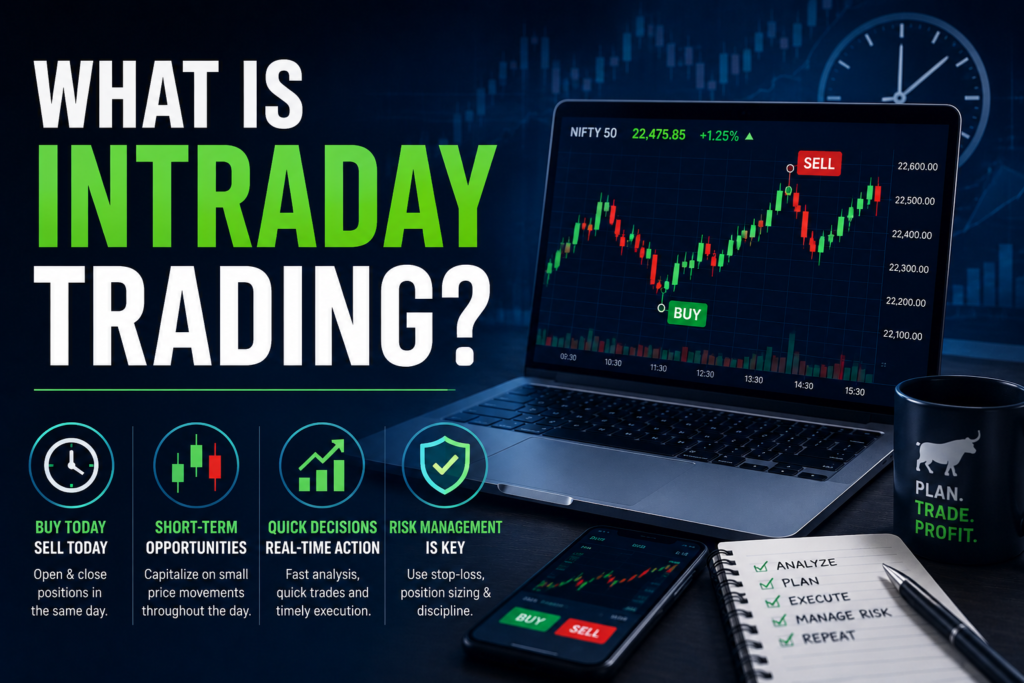
Intraday trading means buying and selling stocks or shares within the same trading day. The word “intraday” itself means “within the day.” So when you do intraday trading, you open a trade in the morning and close it before the market closes in the evening all on the same day.
In normal investing, people buy shares and hold them for months or years. But in intraday trading, there is no holding overnight. You must complete your buy and sell transaction on the same day, no matter what happens.
For example, if the Indian stock market (NSE/BSE) opens at 9:15 AM, you may buy 50 shares of a company at ₹1000 per share. By 3:00 PM, if the price goes up to ₹1020, you sell those shares. Your profit in this case is ₹20 per share = ₹1,000 total. That is intraday trading in action.
Simple Definition
Intraday trading is the act of buying and selling financial instruments like stocks, currencies, or commodities within the same trading session (same day), with the goal of making a profit from small price movements.
2.How Does Intraday Trading Work?
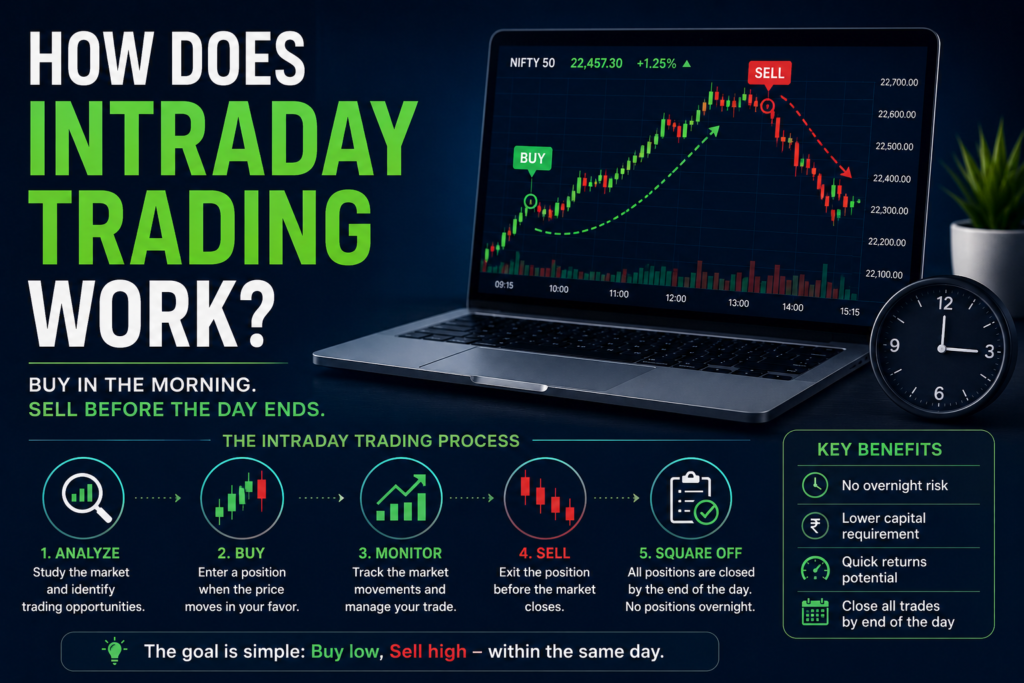
Understanding how intraday trading works is not that hard. Let’s understand this below step by step.
When you open a Demat and trading account with a broker (like Zerodha, Upstox, Angel One in India or TD Ameritrade, Robinhood in the USA), you get access to a trading platform. On this platform, you can see live stock prices changing every second.
Intraday traders watch these price movements very carefully. They use charts, technical indicators, and news to decide when to buy and when to sell. They try to catch small price movements sometimes just ₹5 or ₹10 per share but since they trade in large quantities, even a small move can mean a good profit.
Same-Day Settlement
All trades opened must be closed before the market closes (3:30 PM in India).
Margin / Leverage
Brokers give extra buying power (5x–10x margin) to intraday traders to trade with more capital.
Both Ways Profit
In intraday, you can profit when prices go UP (Buy) or go DOWN (Short-sell).
Live Charts & Tools
Traders use candlestick charts, RSI, MACD, and moving averages to make decisions.
3.Intraday Trading vs Long-Term Investing
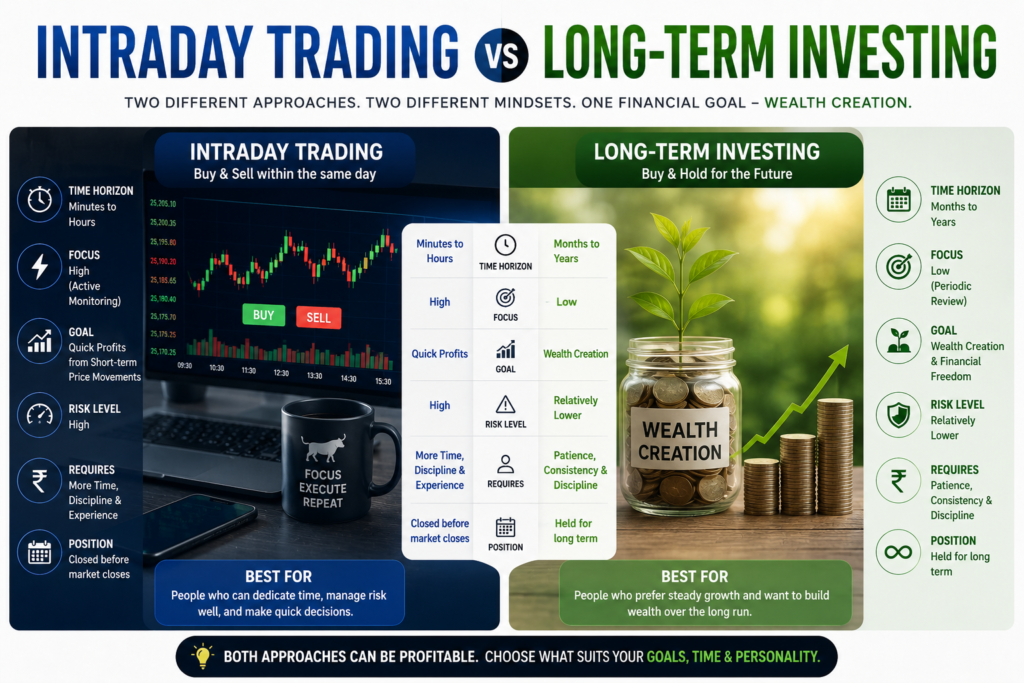
Many beginners get confused between intraday trading and long-term investing. Let’s see the difference in a simple table.
| Feature | Intraday Trading | Long-Term Investing |
| Holding Period | Same Day | Months to Years |
| Goal | Quick Profit from Price Moves | Wealth Building Over Time |
| Risk Level | High | Medium to Low |
| Capital Needed | Lower (with margin) | Higher |
| Skills Required | Technical Analysis, Speed | Fundamental Analysis, Patience |
| Tax (India) | 15% STCG (Short-Term) | 10% LTCG after ₹1L gain |
| Stress Level | Very High | Low |
| Time Required | Full-time / Active | Part-time / Passive |
4.Benefits of Intraday Trading
Even though intraday trading sounds risky, it does have some real benefits especially for those who are disciplined and well-trained.
Benefits (Pros)
- Profit in a single day — no waiting months
- No overnight market risk (positions close daily)
- Leverage allows more buying power with less capital
- Can profit even when markets are falling (short-selling)
- High liquidity — you can enter and exit quickly
- Exciting and keeps you engaged with markets
- No need to lock money for long periods
Risks (Cons)
- Very high risk — most beginners lose money
- Requires constant screen watching (stressful)
- Transaction costs and brokerage can eat profits
- Emotional decisions lead to big losses
- Requires time and strong technical knowledge
- Leverage can multiply losses too
- Not suitable for those with a full-time job
5.Top Intraday Trading Strategies for 2026
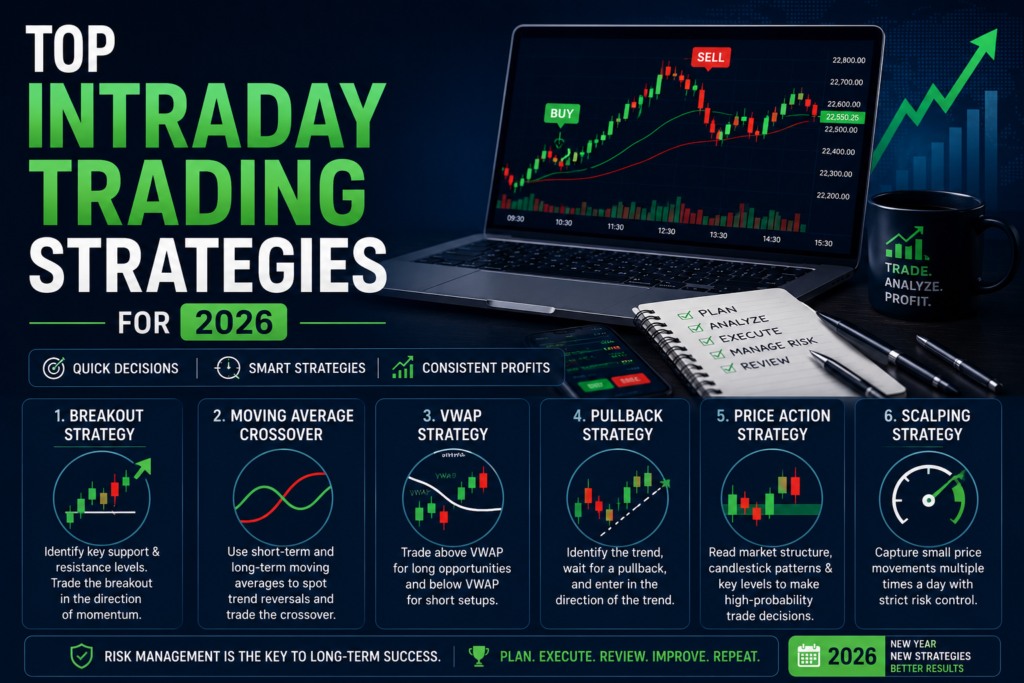
If you want to do intraday trading successfully, you need a solid strategy. Here are some of the most popular and effective intraday trading strategies used by traders in 2026.
5.1 Momentum Trading
In momentum trading, you look for stocks that are moving very fast either going up or down strongly. You join that movement and ride the wave until it slows down. For example, if a stock suddenly jumps from ₹100 to ₹110 in 15 minutes due to good news, a momentum trader will buy it expecting further rise.
5.2 Breakout Trading
A breakout happens when a stock breaks above a resistance level (a price it struggled to cross before). In breakout intraday trading, you buy the stock the moment it breaks that level, expecting a big move upward. This is very popular strategie in Indian intraday traders.
5.3 Scalping
Scalping is a very fast style of intraday trading. Scalpers take multiple small trades in a day. They aim for very small profits maybe ₹1 or ₹2 per share but they do this many times. Scalping requires very fast internet, a good trading platform, and extremely sharp focus. It is not recommended for beginners.
5.4 Reversal Trading
This strategy involves finding stocks that have fallen a lot and are now showing signs of bouncing back. Traders look at oversold signals on indicators like RSI (Relative Strength Index) to identify when a stock might reverse direction. When they see the right signal, they buy the stock expecting it to recover quickly.
5.5 Gap and Go Strategy
Sometimes a stock “gaps up” or “gaps down” at market open — meaning it opens significantly higher or lower than where it closed the previous day. This usually happens due to overnight news or earnings reports. The Gap and Go strategy involves entering a trade in the direction of the gap and capturing that initial strong move.
🔗 Want to Learn More About Strategies?
You can explore in very detailed way the intraday trading strategies and beginner courses on trusted platforms like Investopedia’s Day Trading Guide – one of the world’s most respected financial education websites to sharpen your knowledge before you start trading with real money.
6.How to Start Intraday Trading in 2026 – Step by Step
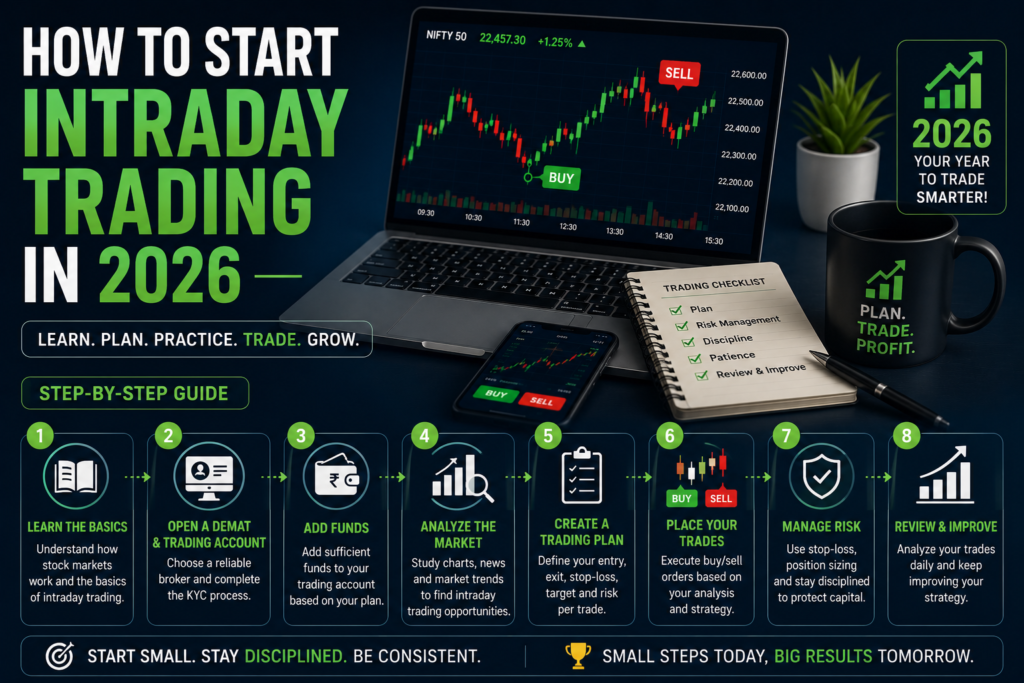
If you are thinking about starting intraday trading in 2026, here is a simple step-by-step process to get started the right way.
Step 1: Open a Demat Account
Choose a reliable broker Zerodha, Upstox, or Angel One in India. For USA, try Webull or TD Ameritrade.
Step 2: Learn the Basics
Study candlestick charts, support/resistance, RSI, MACD, and volume analysis before investing real money.
Step 3: Practice on Paper
Use a paper trading (virtual trading) account to practice without risking real money for at least 30 days.
Step 4: Start Small
Dont go with huge capital at start .Begin with a small capital so that if you lose then afford the losses. One more thing Never ever use borrowed money or your savings for intraday trading.
Step 5: Set Stop-Loss Always
A stop-loss is a price at which you automatically exit to limit losses. NEVER trade without a stop-loss.
Step 6: Keep a Trading Journal
Write down every trade in your journal and it includes information like why you entered, why you exited, and what you learned. Review it time by time.
7.Important Terms Every Intraday Trader Must Know
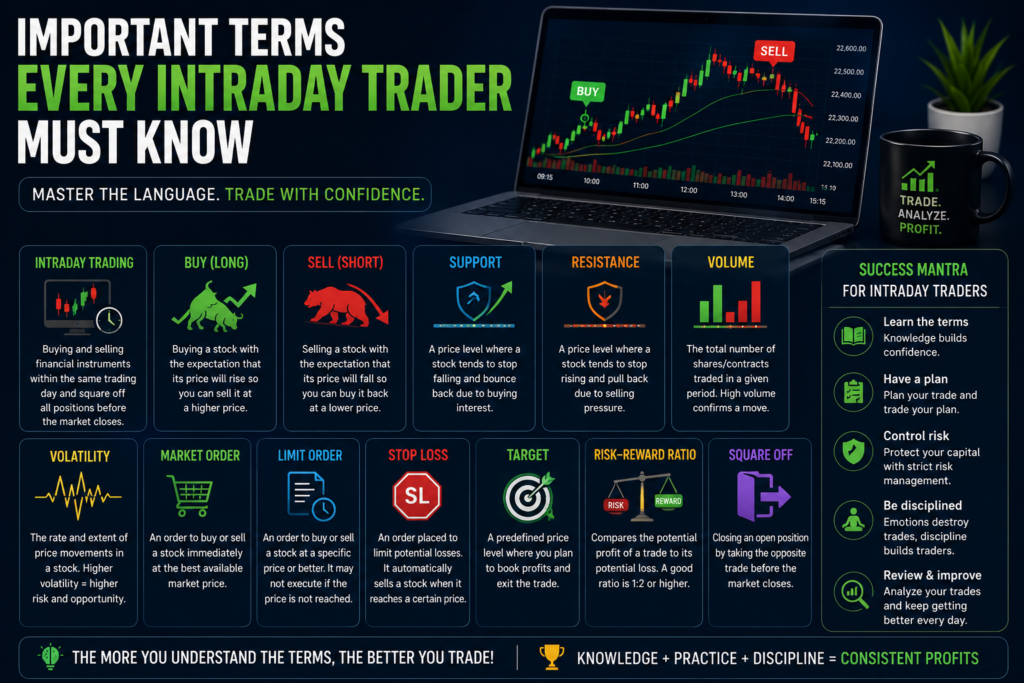
Before you start doing intraday trading, you need to understand some basic terms. Here they are in simple language:
| Term | Simple Meaning |
| Bull Market | Market is going UP Means prices are rising |
| Bear Market | Market is going Downside means prices are also going down |
| Stop-Loss | A fixed price where you exit to stop losing more money |
| Target Price | The price at which you plan to take your profit |
| Leverage / Margin | Borrowed money from broker to trade bigger amounts |
| Candlestick | A chart type showing price movement in a time period |
| Volume | How many shares were traded in a given time |
| Resistance | A price level that a stock struggles to break above |
| Support | A price level where a falling stock tends to stop and recover |
| Short Selling | Selling a stock first and buying it back later at a lower price to profit from a fall |
8. Intraday Trading Tips for Beginners in 2026
Here are some golden intraday trading tips that every beginner must follow in 2026 to protect their money and grow their skills:
- Always use a stop-loss – this is the First rule of intraday trading. No exceptions.
- Trade only 1–2 stocks per day when you are a beginner. Do not track 10 stocks at once.
- Do not overtrade because in desire to recoveryour losses by making multiple trades in one day is a very common mistake.
- Avoid trading during the first 15 minutes of market open – prices are most unpredictable during this time.
- Check the news before trading – major events like RBI policy, company results, or global news can cause wild price swings.
- Never use your life savings for intraday trading. Only trade with money you are okay to lose.
- Control your emotions – fear and greed are the biggest enemies of any intraday trader.
- Learn technical analysis – understanding charts is the most important skill for intraday trading success.
For a deeper understanding of market psychology and risk management, you can also read resources from Zerodha Varsity a completely free and excellent learning platform trusted by millions of Indian traders. Their modules on technical analysis and trading strategies are highly recommended.
Read More : Is Crypto Legal in India? Full Guide 2026 | Rules & Laws Explained
Read More : Best ETFs for Beginners : 10 Top Picks to Start Investing Smart in 2026
Read More : Will the Stock Market Crash? Expert Warnings, Risk Factors & What to Do in 2026
What is intraday trading in simple words?
Intraday trading means buying and selling stocks on the same day. You open a trade in the morning and close it before the market closes in the evening. The goal is to make a profit from small price changes that happen during the day.
Is intraday trading safe for beginners?
Intraday trading is considered high-risk, especially for beginners. Studies show that more than 70–80% of new traders lose money in intraday trading. It is safe only when you have proper education, a good strategy, strict stop-losses, and strong emotional control. Always start with small capital and practice on paper trading first.
How much money do I need to start intraday trading in India?
In India, there is no fixed minimum amount to start intraday trading. Technically, you can start with as little as ₹500–₹1,000. However, a practical starting amount for meaningful learning is ₹10,000 to ₹25,000. Remember, you should only trade with money you can afford to lose completely.
Can I do intraday trading as a full-time career in 2026?
Yes, many people do intraday trading as a full-time career. But it takes years of learning, consistent practice, and very strong discipline. Most successful full-time traders spent at least 2–3 years learning before making consistent profits. It is not a “get rich quick” path — it is a serious career that demands dedication, just like any other profession.
Conclusion
So now you know what intraday trading is buying and selling stocks within the same day to profit from price movements. It is an exciting and potentially rewarding activity, but it is also one of the most challenging and risky forms of trading that exists.
Intraday trading is not for everyone. It requires time, discipline, knowledge, emotional control, and a solid strategy. If you are a beginner in 2026, the best approach is to first educate yourself thoroughly, practice with paper trading, and only enter the live market when you feel confident and prepared.
Remember the golden rule of intraday trading: never trade without a stop-loss, never risk money you cannot afford to lose, and always keep learning. The market is a great teacher but it charges very high tuition fees to those who do not prepare well.
Disclaimer: This article is for educational purposes only. It is not financial advice. Please consult a SEBI-registered financial advisor before making any investment decisions.