
Introduction: Why the Commodities Natural Market Matters Today
Every time you fill up your car, buy vegetables, or switch on a light , you are already connected to the commodities natural market. This market is one of the oldest and most powerful forces in the world economy. Yet, many people do not fully understand how it works or why prices go up and down.
In 2026, the natural commodities market is more important than ever. Overall commodity prices are forecast to rise 16% in 2026, driven by soaring energy and fertilizer prices and record-high prices for several key metals. That means everything from your grocery bill to your electricity bill is being shaped by this market right now. World Bank Group
This article explains the commodities natural market in very simple language. Whether you are a student, a small investor, or just a curious reader, this guide is for you.
Table of Contents
What Is the Commodities Natural Market?
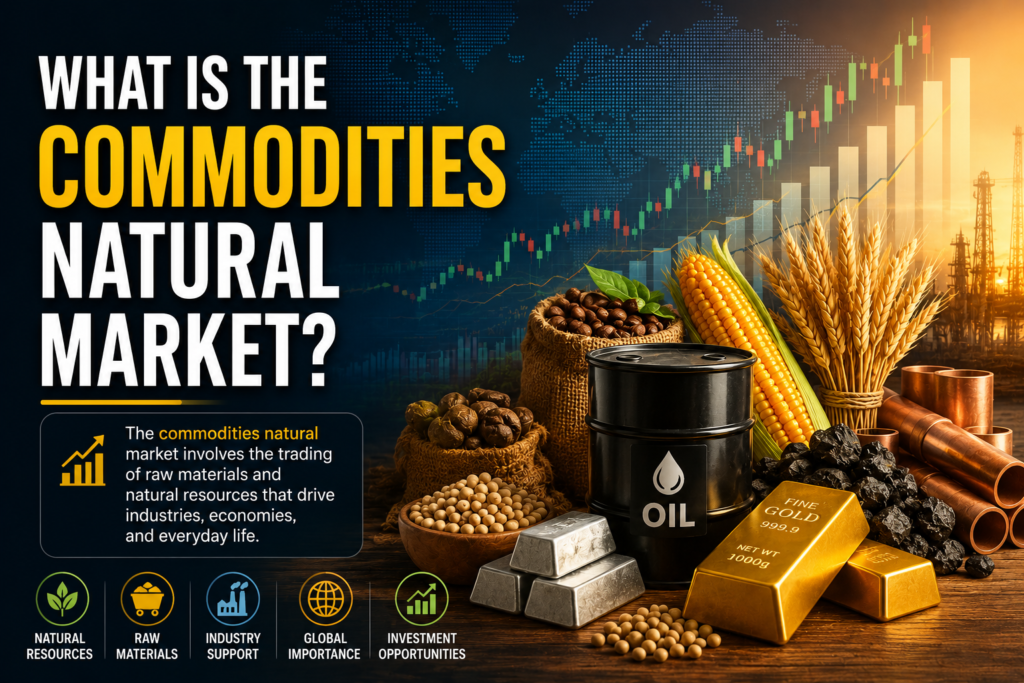
The commodities natural market is a place physical or digital where raw materials from nature are bought and sold. These raw materials are called natural commodities. They are things that are grown, mined, or extracted from the earth.
A commodities market is a marketplace for buying, selling, and trading raw materials or primary products, ranging from agricultural goods like wheat and corn to precious metals such as gold and silver, and even energy resources like oil and natural gas. Pyth Network
In simple words: if it comes from nature and people trade it, it is a natural commodity.
The commodities natural market has two main types of trading:
Spot Market – You buy or sell the commodity right now at today’s price.
Futures/Derivatives Market – You agree today to buy or sell a commodity at a fixed price on a future date. This helps farmers, airlines, and factories plan their costs in advance.
For example, an airline might lock in today’s oil price for the next six months so it doesn’t suffer if prices jump later. This is called hedging — and it is one of the most important functions of the commodities natural market.
Types of Natural Commodities
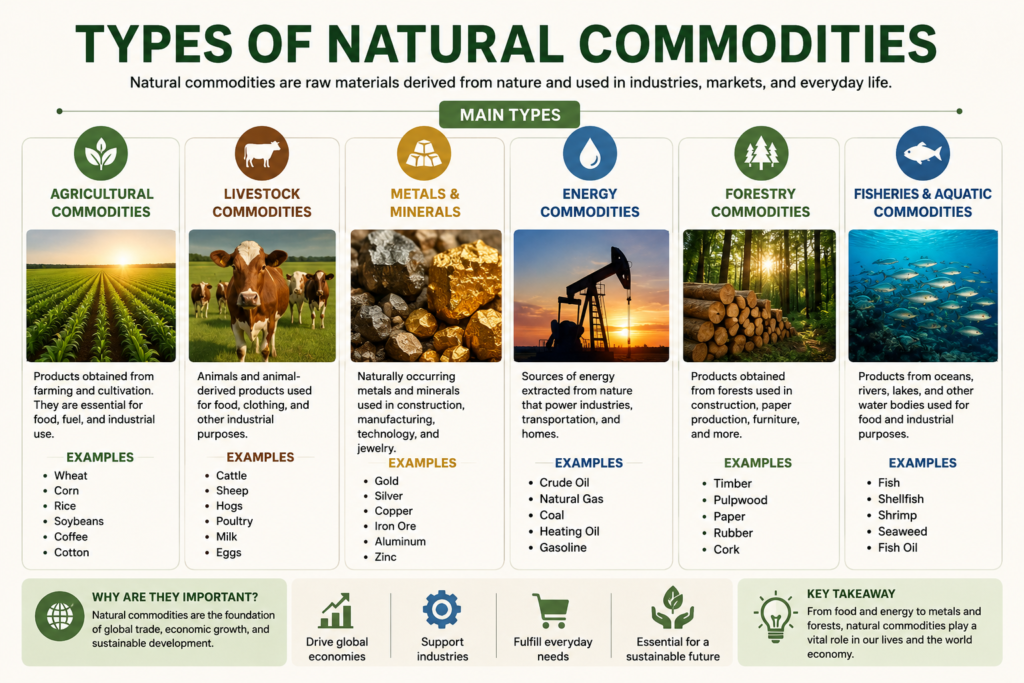
The commodities natural market is divided into two big families: Hard Commodities and Soft Commodities.
Hard commodities encompass natural resources like metals and energy, featuring gold, silver, natural gas, and oil. Hard commodities serve as benchmarks for economic stability and are often viewed as indicators of global sentiment. Soft commodities, on the other hand, include agricultural goods and livestock, such as sugar, wheat, and coffee. Soft commodities are influenced by factors ranging from weather conditions and geopolitical events to technological advancements in farming. Pyth Network
Here is a quick breakdown:
Hard Natural Commodities:
- Crude oil and natural gas
- Gold, silver, platinum
- Copper, nickel, aluminum
- Coal and iron ore
Soft Natural Commodities:
- Wheat, corn, rice, soybeans
- Coffee, cocoa, sugar
- Cotton and rubber
- Livestock (cattle, hogs)
Commodities can broadly be categorized into three segments: Energy Commodities – including crude oil, natural gas, coal, and renewable energy components. Metal Commodities – comprising precious metals (gold, silver, platinum) and industrial metals (copper, aluminum, nickel, lithium). Agricultural Commodities – such as grains, oilseeds, coffee, cotton, and sugar. tradingview
Each of these categories behaves differently. For example, gold prices rise when people are scared about the economy. Oil prices rise when there is war or conflict near oil-producing regions. Wheat prices rise when droughts hit farming regions.
The Commodities Natural Market in 2026: What Is Happening?
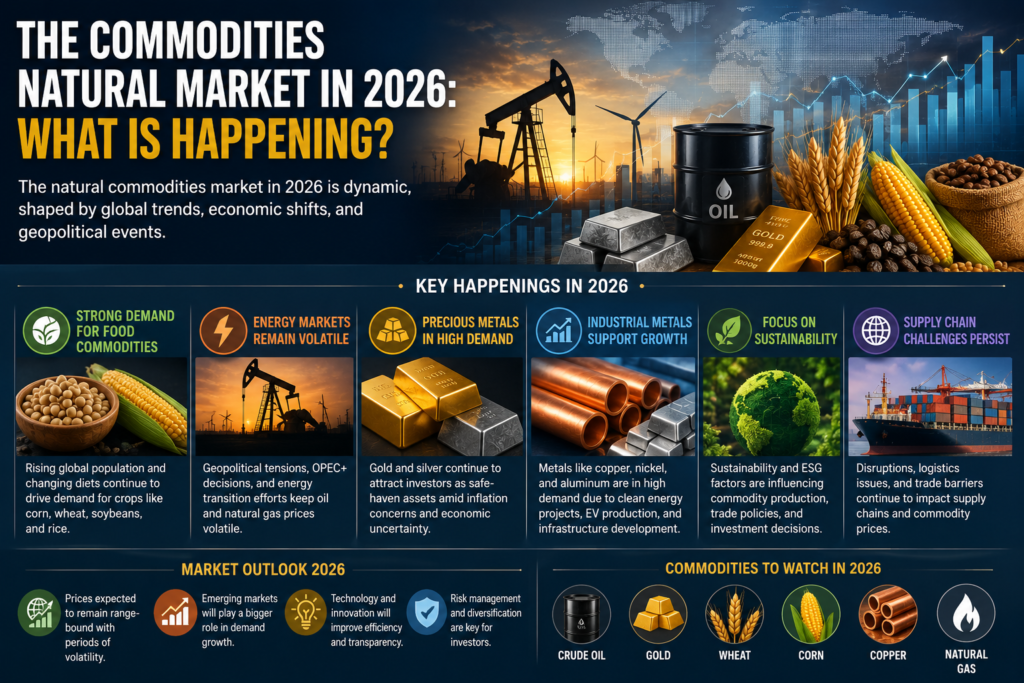
The natural commodities market in 2026 is going through a very active and sometimes unpredictable phase. Here is what is happening across each sector:
1. Energy Commodities – The Biggest Movers
Energy is the most talked-about part of the commodities natural market this year.
Commodity prices were highly volatile in the first quarter of 2026, driven by supply disruption concerns amid geopolitical tensions in the Middle East. Energy prices were particularly affected, with the price of Brent crude rising sharply from $72 a barrel at the end of February to $118 a barrel by the end of March, marking the largest monthly increase on record. World Bank Blogs
This was a massive shock. Natural gas prices also surged. The Asian LNG benchmark surged by 94 percent over the course of March, while European natural gas prices increased by 59 percent. World Bank Blogs
For everyday people, this means higher electricity bills and higher fuel costs. For investors in the natural commodities market, energy has been one of the biggest opportunities and risks of 2026.
2. Precious Metals – Gold Stays Strong
Gold has long been considered a “safe haven” in the commodities natural market. When economies are uncertain, people buy gold.
Gold is expected to enter a consolidation phase in 2026, with prices averaging approximately $4,300–$4,400 per ounce. That is an incredibly high price reflecting how nervous investors are about the global economy. Natixis
Natural gas and precious metals have led the price gains in 2025, and this trend is expected to continue in 2026. Precious metals will continue to benefit from safe-haven demand amid geopolitical uncertainty and currency weakness. Oxford Economics
Silver, platinum, and palladium are also performing well in the natural commodities market this year, though gold remains the star.
Read More : What Is Intraday Trading? A Complete Beginner’s Guide (2026)
3. Industrial Metals – Mixed Picture
Copper is one of the most important metals in the commodities natural market because it is used in wiring, construction, electric vehicles (EVs), and data centers.
Copper demand continued to grow in 2025, driven by energy-transition requirements originating in the transportation sector, as well as emerging demand from data centers. The market enters into a deficit in 2026. Copper supply faces acute long-term pressure, as a boom in copper-intensive data centers coincides with mine disruptions and slow permitting. BloombergNEF
Copper prices are expected to moderate, averaging $10,800–$11,000 per tonne in 2026, which remains elevated by historical standards. Natixis
For nickel, there is a more positive story. Nickel represents a more constructive case within base metals. Prices are expected to average $17,800–$18,000 per tonne, driven primarily by Indonesia’s intention to reduce mining quotas. Natixis
4. Agricultural Commodities – Relatively Stable
Unlike energy, food commodities in the natural market have not seen wild price swings.
Despite the war roiling many markets, the World Bank Group’s agricultural commodity price index remained broadly stable in the first few months of 2026. World Bank Blogs
However, this does not mean agriculture is worry-free. Climate Volatility: Droughts, floods, and heat waves are disrupting harvests worldwide. Geopolitical Uncertainty: Conflicts like Russia-Ukraine have shown how fragile food supply chains can be. Rising Input Costs: Fertilizer, fuel, and transport costs push food prices higher. Crystalballmarkets
The agricultural side of the commodities natural market is closely connected to weather patterns and geopolitics and both are unpredictable in 2026.
Read More : Is Crypto Legal in India? Full Guide 2026 | Rules & Laws Explained
What Drives Prices in the Commodities Natural Market?
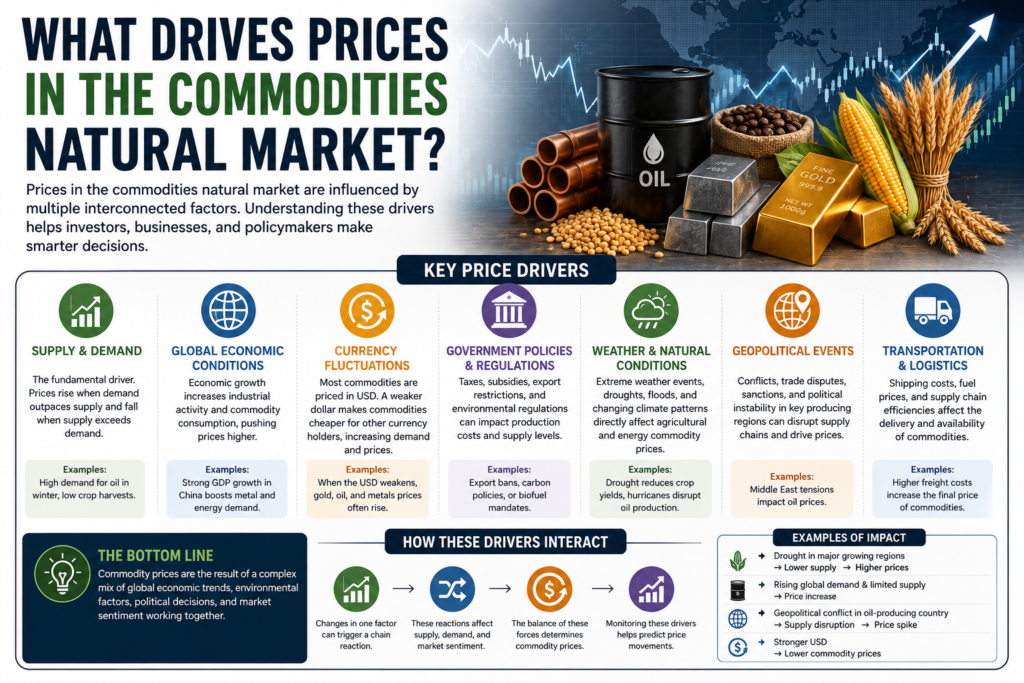
Understanding price movements is key to understanding the natural commodities market. Here are the main factors:
Supply and Demand – If a drought destroys wheat crops, supply falls and prices rise. If a new oil field opens and production increases, oil prices may drop.
Geopolitical Events – Wars, sanctions, and political instability directly affect the commodities natural market. The Middle East tensions of early 2026 are a perfect example.
Currency Strength – Most natural commodities are priced in US dollars. When the dollar weakens, commodities become cheaper for buyers using other currencies, boosting demand and pushing prices up.
Global Economic Growth – Commodity markets remain closely tied to the global business cycle. Investment-heavy sectors such as construction and manufacturing major consumers of energy and metals are particularly exposed. Oxford Economics
Weather and Climate – For agricultural commodities and energy (think cold winters driving gas demand), weather is a powerful price driver.
Investor Sentiment – Large banks, hedge funds, and individual traders all buy and sell in the commodities natural market. When fear rises, gold goes up. When growth expectations rise, copper and oil tend to follow.
How to Invest in the Commodities Natural Market
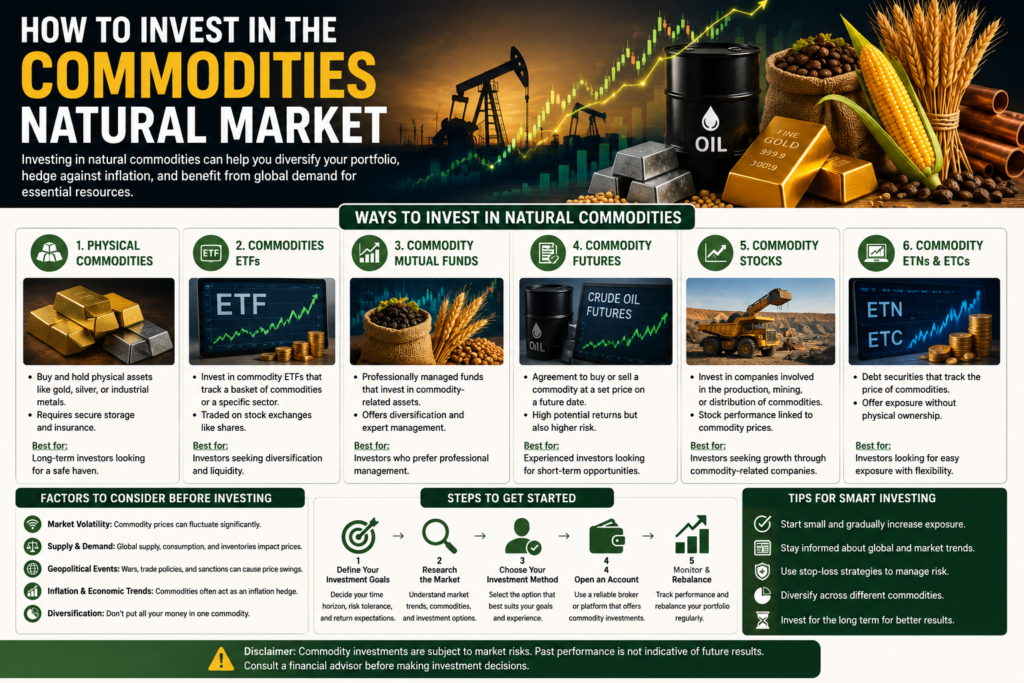
Investing in the commodities natural market is not just for big banks and professional traders anymore. Here are the most common ways ordinary investors can participate:
1. Commodity ETFs (Exchange-Traded Funds) These are funds that track the price of a commodity or a basket of commodities. You buy shares just like you would buy a stock. It is the easiest way for beginners.
2. Commodity Futures You agree to buy or sell a natural commodity at a fixed price on a future date. This is more complex and carries higher risk, but is widely used by experienced traders.
3. Commodity Stocks Buying shares of companies that produce commodities like gold mining companies, oil producers, or agricultural firms is an indirect way to invest in the natural commodities market.
4. Physical Ownership For gold and silver, some investors simply buy and hold the physical metal. This is less practical for oil or wheat, but very common for precious metals.
According to Commodity.com, one of the leading resources for commodity education, producers hedge, traders speculate, and consumers from airlines to bakeries lock in costs. Learning how these markets work helps investors ride cycles and avoid hype. Commodity.com
For anyone starting out, learning how to read basic price charts and understanding supply-demand basics will go a long way in navigating the commodities natural market.
Risks of the Commodities Natural Market
No investment is without risk. The natural commodities market carries some specific risks that every investor should understand:
High Volatility – As seen in early 2026, commodity prices can move sharply in a very short time. Oil moved from $72 to $118 per barrel in just one month. That is exciting for traders but dangerous for unprepared investors.
Leverage Risk – Futures contracts often involve borrowing money (leverage). This can multiply both gains and losses.
Storage and Logistics – If you physically own oil or wheat, you have to store it. This adds cost and complexity.
Geopolitical Uncertainty – A sudden war, sanction, or political change can flip the commodities natural market overnight.
Climate and Weather Risk – A bad monsoon season, unexpected frost, or prolonged drought can instantly change prices for agricultural natural commodities.
Read More : Best ETFs for Beginners : 10 Top Picks to Start Investing Smart in 2026
Why the Commodities Natural Market Is Important for India
For Indian readers, the natural commodities market is especially relevant. India is one of the world’s largest producers and consumers of agricultural commodities like wheat, rice, cotton, and sugar. India also imports large quantities of crude oil and gold.
When global oil prices rise, India’s import bill increases, which can weaken the rupee and cause inflation. When gold prices rise globally, it affects millions of Indian households who hold gold as an investment.
The Multi Commodity Exchange (MCX) and the National Commodity and Derivatives Exchange (NCDEX) are India’s main platforms for trading in the commodities natural market. These exchanges allow farmers, businesses, and investors to trade in gold, silver, crude oil, copper, and agricultural products.
What is the commodities natural market in simple words?
The commodities natural market is a marketplace where raw materials from nature — like oil, gold, wheat, and gas — are bought and sold by producers, traders, and investors.
What are the most traded natural commodities in 2026?
The most traded natural commodities in 2026 are crude oil, natural gas, gold, silver, copper, wheat, and soybeans. Energy commodities are seeing the most price movement this year due to Middle East tensions.
Is it safe to invest in the natural commodities market?
Like any investment, the commodities natural market carries risk. Prices can be highly volatile. It is important to research thoroughly, start with safer instruments like ETFs, and never invest money you cannot afford to lose.
How does geopolitics affect the commodities natural market?
Wars, sanctions, and political instability can disrupt the supply of natural commodities, causing prices to spike sharply. The 2026 Middle East conflict is a current example that pushed oil prices to their highest monthly increase on record.
What is the difference between hard and soft natural commodities?
Hard commodities are mined or extracted – like gold, oil, and copper. Soft commodities are grown – like wheat, coffee, sugar, and cotton. Both are traded in the commodities natural market but respond to different price drivers.
Can beginners invest in the natural commodities market?
Yes. Beginners can start with commodity ETFs, which are easy to buy through a stock brokerage account. This is lower-risk than futures trading and gives exposure to the natural commodities market without the complexity.
Why is gold so expensive in 2026?
Gold prices are high in 2026 because of strong global uncertainty including geopolitical conflicts, currency weakness, and investor demand for safe assets. Central banks around the world are also buying gold in large quantities.
How does weather affect the commodities natural market?
Weather affects agricultural natural commodities directly. A drought can destroy crops and reduce supply, pushing prices up. Cold winters increase demand for natural gas and heating oil, driving energy prices higher.
Conclusion
The commodities natural market in 2026 is a fast-moving, high-stakes arena that affects every person on the planet – whether they invest in it or not. Energy prices are surging due to geopolitical shocks, gold is holding firm as a safe haven, copper is in deficit due to the green energy transition, and agricultural markets remain relatively steady but vulnerable to climate risks.
Understanding how this market works – the types of natural commodities, the forces that move prices, and the ways to participate – puts you in a much stronger position as a consumer, a business owner, or an investor.
The commodities natural market is not just a financial concept. It is the living, breathing backbone of the global economy. Paying attention to it in 2026 is not optional – it is essential.